






Monuments
LT Dillwyn Parrish Starr Cenotaph -Coldstream Guards
Norton Plaque (Founder of the American Volunteer Motor Ambulance Corps)
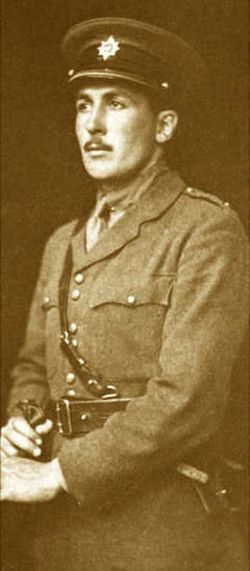
DILLWYN P. STARR, OF THE COLDSTREAM GUARDS
It is doubtful if any one of the American youths who entered the war in its early stages in behalf of the Allies saw more varied service than did Dillwyn Parrish Starr, of Philadelphia, whose father, Dr. Louis Starr, has had printed for private circulation a memorial volume, "The War Story of Dillwyn Parrish Starr." For at first Starr drove an ambulance in Richard Norton's corps in northern France and in Flanders; then he served with an English armored motor-car squadron, under the command of the Duke of Westminster, in Flanders; then, from early in the summer of 1915 until November, he was in charge of a motor-car squadron in Gallipoli; finally on his return he joined the Coldstream Guards, accepted a commission as second lieutenant, and was killed while gallantly leading two platoons in a charge on September 15, 1916, having seen two years of varied service. At the time of his death he had reached the rank of first lieutenant.
Starr's desire at the outset was, as he expressed it, "to see the war," and so great was his eagerness to get to the field of operations that he shipped as a sailor on the liner Hamburg, which the American Red Cross sent abroad the middle of September, 1914. By the end of October he was driving an ambulance, a powerful Mercedes, on the Belgian frontier. Starr's experience in the ambulance service opened his eyes to the nature of the struggle upon which the Allies had entered and to the real character of their enemy, and made him long, as he said later, "to get at them with cold steel."
When, therefore, an opportunity came to effect a transfer to the British Armored Car Division, he grasped it eagerly. Early in March, 1915, Starr was near the British front lines in northern France, as one of the crew of a heavy armored car carrying a three-pound gun, in the squadron under the Duke of Westminster. An entry in his diary, with its amusing anticlimax in the last sentence, describes the work of his car in a fight near Neuve Chapelle, southeast of Armentières:
March 13. Hot day! Up at 3 A. M. and on guard. Shells still passing over and falling in town [Laventie]. The Duke came at 9 o'clock to take us out. Went in same direction as yesterday afternoon but to more advanced post. Heavy fighting going on. Took up position 200 yards south of cross-roads at Fauquissart, behind some buildings that were half battered down. Got range of house occupied by Germans who were holding up our advance and fired forty-two shells, all telling and driving them out. They were shot down by our infantry, who occupied what was left of the building a short time afterward. Enemy artillery found us, and their shells began dropping all about us; also under rifle fire and had to keep cover. Shells were striking ten yards away in the mud, and one splashed water into the car. Finally obliged to back away, as road too cramped to turn; moved very slowly and it seemed we were going to get it sure---close squeeze ! Got back to Laventie at 11 o'clock, and in afternoon painted car and had my hair cut.
Like Johnny Poe of the Black Watch, Dill Starr, as he was called by his classmates at Harvard, where he was graduated in 1908, was a football player of note, having won a place on the university team. A far-away echo of his gridiron days is heard occasionally in his diary. Thus he notes, in anticipation of immediate active service:
In afternoon were told to get some sleep and I did, sitting in chair. At four o'clock had tea. Thinking of going out gives me the same feeling as before a football match.
Nearly a year and a half later, when he was a lieutenant in the Coldstream Guards, in France, a match game of soccer, of which Starr knew little or nothing, was arranged with a team from the crack rival regiment in the British service, the Grenadier Guards. Starr was persuaded, much against his will, to play with his fellow Coldstreamers, with this result:
The match with the Grenadiers came out a tie. I was lucky enough to make a goal for our side in the last thirty seconds. The score was three all.
In May Starr was gazetted sublieutenant in the Royal Navy Volunteer Reserves, and in June, after a period of further study in gunnery, he sailed, with another officer and twenty-five men, for Gallipoli. The evidence of Starr's letters and diary will be valuable to the historian who seeks the causes for the ghastly failure of that campaign. They were, in a sentence, according to Starr, bad organization, bad management, lack of foresight and lack of energy.
Having landed, the middle of July, 1915, at Cape Helles, he outlined the situation as it appeared to him a week later:
This is the most wonderful looking place I ever saw, the whole ground is covered with dugouts, and even the mules have their little shelters. The hill, Achi Baba, is only about three miles away, so you can imagine how far we have advanced. On the first day of the landing we were further advanced than we are now; the troops, you see, had no food, water, etc., so they had to fall back after the first rush. The Turks shell the Peninsula very often, but don't do an awful lot of damage.
Of the costly and futile attack by the British on the hill of Achi Baba, early in the following August, Starr wrote:
Well, the attack has been made and was a complete failure here. Almost four thousand men went out and very few came back. Some monitors and ships bombarded Achi Baba for two hours. The Turks during this moved down into a gully and came back after it to their second line and massed four deep to meet our men. I was on higher ground with four guns and could clearly see our charges of the 6th and the morning of the 7th. The men went out in a hail of bullets and it was a wonderful sight to see them. Many of them fell close to our parapets, though a good number reached the Turkish trenches, there to be killed. On the morning of the 7th the Turks made a counter attack and drove our men out of the lightly-held trenches they had taken. Our guns fortunately took a lot of them; my two guns fired a thousand rounds into their closely formed mass.
Under orders Starr returned to England late in November, to find that the Armored Car Division had been disbanded. At the suggestion of his college mate, Walter G. Oakman, Jr., who had been with him in both the ambulance service and the Armored Car Division, and who was then in the Coldstream Guards, Starr decided to accept a commission, which had been offered to him, as second lieutenant in the same regiment, one of the most famous in the British Army. He thereupon went into strict training which lasted six months, until midsummer, 1916. Having similar tastes, especially in sports, he fraternized cordially with his fellow officers, fell in easily with the traditions of the regiment, and looked forward with eagerness to the time when he could lead his men in a charge. To do this was the highest point which his ambition as a soldier touched.
The regiment saw some trench work in August and early in September, but was in no serious engagement until the middle of the month. Under date of September 11, four days before he was killed, Starr wrote a letter to his friend, Harold S. Vanderbilt, in the course of which he said:
I came out to France on the 11th day of July and am now in the 2nd Battalion Coldstream Guards. We expect to have a very hot time within the next few days. I believe we are going to hop the parapet, so there is a good chance of my getting back to England with a "blighty" within the next week. There is a lot of hell popping about here and the artillery fire is something stupendous.
Things are looking a little better for the Allies now, although it is not over yet by a long shot.
The last letter from him was written the following day, September 12. In it Starr said:
They hope here that we shall break through the German lines, but I have my doubts. There is a chance, however, and if we do it will make all the difference in the world.
They didn't break through, but they attained their immediate objective, making possible the capture of Les-Boeufs the next day.
On the 15th the three battalions of the Coldstream Guards attacked the enemy near Ginchy, a few miles east of Albert. They drove the Germans out of their three lines of trenches, but at heavy cost, a nest of machine-guns, which the British tanks had failed to silence, taking a frightful toll of lives. Lieutenant Starr, leading his two platoons, was caught by this enfilading fire and killed as he sprang upon the parapet of the first German trench.
In a letter written from the hospital to Dr. Starr, Corporal Philip Andrews, of Starr's platoon, described this charge:
The order then came to charge the trench; in that he got hit while leading us in the charge.
I did not see him fall, but was told while in the captured trench that he had been shot through the heart. We all knew we had lost a splendid leader who knew no fear. He knew, and so did I, that we should have a terrible fight to gain the trench, but he was cool and cheered up all his men, and I am sorry he did not live to see the spirit he had put into them in the final charge. He died a hero, always in front of us.
Colonel Drummond-Hay, commanding the Coldstream Guards, wrote to Dr. Starr:
Previously to the War we had ties which kept the Regiment in very friendly touch with the U. S. A., but now we are bound to you by a very much closer bond, your son, and others like him, who never rested till they were able to give us their active assistance in upholding the honor of the Regiment in this tremendous War, and this will never be forgotten in the Regiment, as long as its name endures.
To have voluntarily given his life as your son has done for the cause of right and in support of an abstract principle, is quite the noblest thing a man can do. It is far higher than giving it in fighting to safeguard one's own Hearth and Home, and for the maintenance of the Empire of which one is one's self a unit. And, believe me, we greatly appreciate this spirit in which so many Americans are fighting on our side.
A cenotaph also remembers him in his home of Philadelphia, Pennsylvaia in the Laurl Hill Cemetery.
Source: http://www.gwpda.org/wwi-www/AmerVolunteers/Morse2%263.htm