




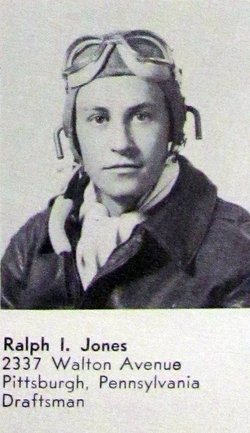
Monday, August 28, 1944. It was a bright sunny day in the small village of Boskovštejn, in then Czechoslovakia, now the Czech Republic. Shortly before 9:00 am, five hundred miles to the south, nineteen year old Second Lieutenant Ralph I. Jones climbed aboard “Birmingham Boomerang,” his P-51B Mustang, a single-seat, single-engine fighter airplane. That day was his first combat mission. It was also his last.
The 15th Army Air Force, 31st Fighter Group, 308th Squadron was based in San Severo, Italy. First Lieutenant Walter J. Goehausen, Jr. led “Blue Flight,” a group of four fighter airplanes. 2/Lt. Jones was his wingman. In position 3 was First Lieutenant Jack R. Smith, while Second Lieutenant Eugene P. McGlauflin flew as his wingman in position 4.
Fourteen more P-51s from the 308th Squadron took off that day. They joined other squadrons in the same Fighter Group, and in turn they joined other Fighter Groups for a total of 149 fighter aircraft. The 31st Fighter Group’s leader that day was Lieutenant Robert J. Goebel, a combat ace.
Their mission: Escort and protect 168 B-17 bombers from the 5th Wing as they bombed the Moosbierbaum oil refinery and adjacent chemical works 25 miles northwest of Vienna, Austria. As fighter pilots, they were to protect the bombers from enemy aircraft as they flew into, over, and out of enemy territory. With ten crew members per bomber, there were 1,680 lives depending on these 149 fighter pilots.
2/Lt. Jones was assigned to the 308th squadron just six days prior to the bombing mission to Moosbierbaum. He earned his wings as a fighter pilot back in March 1944 and was finally shipped overseas to San Severo by August.
P-51 Mustangs from the 31st Fighter Group taxi at San Severo, Italy in May 1944. This scene is probably similar to what 2/Lt. Jones experienced the morning of August 28, 1944. (Fold3, 2007a)
P-51 Mustangs from the 31st Fighter Group taxi at San Severo, Italy in May 1944. This scene is probably similar to what 2/Lt. Jones experienced the morning of August 28, 1944. (Fold3, 2007a) Click image for larger view
The bomber formation reached the target area about 10:45 am, where plane after plane dropped their bomb loads. The attack lasted about 45 minutes.
B-17 bombers leave the Moosbierbaum, Austria target area, August 28, 1944. The city is partially obscured by defensive smokescreens. (Fold3, 2007b)
B-17 bombers leave the Moosbierbaum, Austria target area, August 28, 1944. The city is partially obscured by defensive smokescreens. (Fold3, 2007b) Click image for larger view
In total, 70 to 80 enemy fighters resisted the attack with their own counter-attacks (Carter, 1991). At 11:20 am Lt. Goehausen and the pilots of Blue Flight encountered three such enemy fighters, flying Focke Wulf FW-190 aircraft. In an instant, they engaged the enemy. 2/Lt. Jones as wingman, began to follow Lt. Goehausen as he dove into battle. In the fast-paced confusion of armed confrontation, it was the last moment his fellow pilots saw 2/Lt. Jones.
On the ground however, 2/Lt. Jones was still very much in sight. The men, women and children of Boskovštejna and the nearby village of Jevišovic listened to the roar of engines and rat-a-tat-tat of gunfire, while watching the small specks in flight above them. The dog fight was already in progress when they came upon Boskovštejn from the northwest flying in the direction back towards Vienna in the southeast.
In an instant a loud explosion befell the American pilot. A wing separated from the fuselage and black smoke billowed as the plane fell in a spiraling spin to the ground.
A large crowd of villagers rushed to the crash, but flames and exploding ammunition kept them from getting too close. They eventually saw a gruesome scene: The charred torso of the unidentified airman, without a head, with no legs and only one arm. Body parts and wreckage were scattered over a large area.
Local authorities duly reported the crash to Nazi officials, including the Gestapo, and the crash site was placed under guard. Villagers were coerced into searching for the missing wing, which still contained two machine guns and ammunition. They were also ordered to turn in any artifacts they took from the crash site. Within days the wreckage was taken away and the plane’s components analyzed.
It is reported the Nazi officer in charge ordered dirt be thrown over the pilot’s body. Local citizens appealed and were able to take the body to Jevišovic for a hasty burial ceremony. Upon returning to base, Lt. Goehausen and Lt. Smith submitted statements for the Missing Air Crew Report. This report was required whenever an airman went missing or was killed in action. After the war, in August 1946, the citizens had raised funds and erected a black marble obelisk in memory of this unknown American hero. Politicians, military leaders, school children, and the citizens of Boskovštejna and Jevišovic attended the dedication ceremony. It is inscribed: „Na památku americkému letci zde sestřelenému v leteckém boji 28.8.1944,“ which translates “In memory of the American airman who was shot down in air combat August 28, 1944. A few weeks later in September 1946, a United States Army detail came to exhume the body of 2/Lt. Jones. Another ceremony was held, in which local school children sang the American and Czechoslovakian national anthems. The school headmaster spoke in English about this hero’s sacrifice for their freedom. He thanked the US delegation for helping to liberate them and promised the airman would always be remembered with gratitude. His body was then brought in procession from Jevišovic past the monument and on to Boskovštejna, where the citizens placed bouquets of flowers.
At its dedication and for decades later, the monument commemorated only an unknown American flier. The pilot’s name was never communicated to the citizens. This changed in 1990 when a plaque was affixed indicating “James Ralph,” which unfortunately is incorrect. The citizens did not learn the actual name of 2/Lt. Jones until the 50th anniversary memorial service in 1994. The plaque was amended with “Jones,” but still incorrectly reads “James Ralph Jones” rather than “Ralph I. Jones.” 2/Lt. Jones was hastily buried in a Jevišovic cemetery in 1944. His body was exhumed in 1946 and transferred to the Lorraine American Cemetery near Saint-Avold, France where he lies in plot C, row 11, grave 89. The solemn reverence and respect shown to 2/Lt. Jones by the people of the Czech Republic is remarkable. It started that fateful day in 1944, and has continued through the decades to today. He was one young man who just earned his wings as a fighter pilot. He was shunned as a rookie by hardened veteran pilots. He flew only one mission, yet did one very extraordinary thing. He had the courage to confront a fierce enemy, above a small village in a foreign land. And in so doing, he touched the minds and hearts of hundreds if not thousands of people, generations later, still grateful for his part in liberating them from Nazi oppression.
Source: https://aafcollection.com/comm/2014/05/18/a-hero-not-forgotten/

PRIVATE CITIZENS SUPPORTING AMERICA'S HERITAGE
American
War Memorials Overseas, Inc.
War Memorials Overseas, Inc.

Jones Ralph I.
Name:
Ralph I. Jones
Rank:
Second Lieutenant
Serial Number:
O-715546
Unit:
308th Fighter Squadron, 31st Fighter Group
Date of Death:
1944-08-28
State:
Pennsylvania
Cemetery:
Lorraine American Cemetery and Memorial Saint-Avold, Lorraine, France
Plot:
C
Row:
11
Grave:
89
Decoration:
Purple Heart
Comments: