





American Presence Museum WW1 -41st Infantry Division
Details:
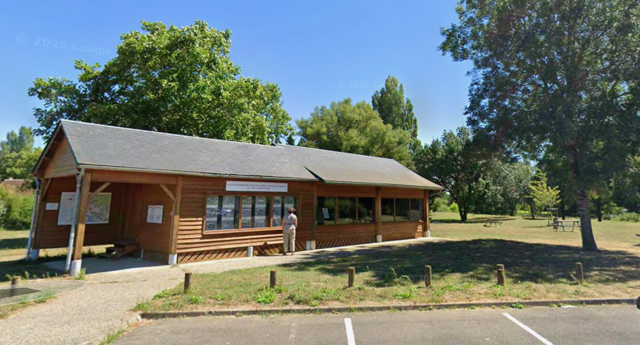
In the travel rest area in next to the American Grafitti monument.
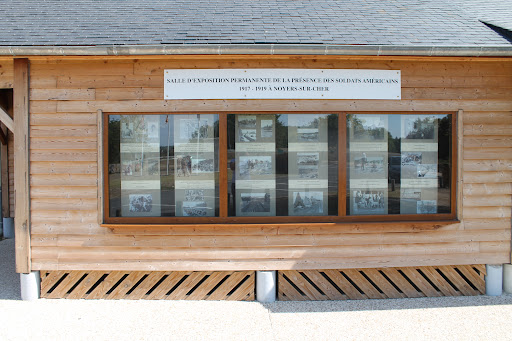
MuseumA small kiosk type building housing information about the American presence in the Cher Valley during World War 1. The museum is known as Musée présence américaine.
The 41st Infantry Division, later named the 1st Depot Division, was stationed here during the war supporting the hundreds of thousands of US troops that pass through this logistical hub in the Intermediate Zone, run by the Supply and Services of the American Expeditionary Forces (AEF). The museum contains many maps and pictures of soldiers in the area in WW1. A large display discusses the role of the 41st Infantry Division during the war.
From the US World Wa1 Commission Website:
During the Spring 1917, a few weeks after the United States entered World War One, the American General Staff decided that the southern sector of the Loir-et-Cher Department would become a key element in its military strategy. An extensive infrastructure took shape under the American Service of Supply Command (camps, depots, communication lines, transport). Among the many localities that welcomed Uncle Sam's Doughboys, an outstanding example is the Cher Valley and in particular, the town of Gièvres. The U.S. Army Engineer Corps arrived in August 1917 and began construction of an immense supply camp, including a cold storage plant that supplied food for American forces dispatched from Dunkerque to Italy. The sector comprising Noyers-sur-Cher/Saint-Aignan was occupied by the 41st Division as a Replacement Camp. Its mission was to receive and maintain personnel, including classification, training, and assignment of soldiers to replace those wounded or killed in battle.
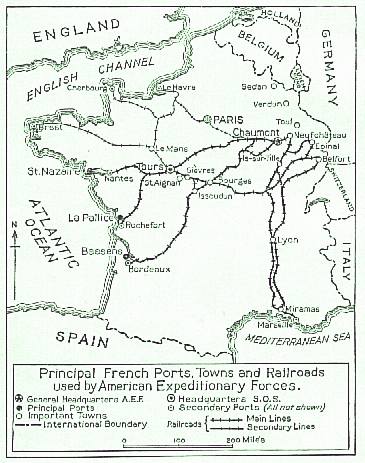
Quickly after the declaration of war, the American General Staff decided to make of the center of France, and particularly the south of the Loir-et-Cher department, an intermediate base between the landing ports (Saint-Nazaire, Brest) and the fighting areas. This rural territory, well connected by railroad lines, was the ideal place to maintain, train or cure soldiers. Moreover, General J. J. Pershing had made a policy to provide each soldier who landed in France 30 days of training & support. One ton of materiel also arrived for each of them.Valérie Chapeau 200
To store and deliver this material in the good time, the Service of Supply chose Gièvres, a community located in the southern of the Loir-et-Cher department, to built an immense supply base capable of furnishing food, clothing, and technical, medical and communications equipment for an army of two million men. This depot was called the G.I.S.D (General Intermediate Supply Depot). Its construction began in august 1917. The hugest cold storage plant of the period, after those of Chicago, was also built in order to provide fresh food for American forces dispatched from Dunkerque to Italy.
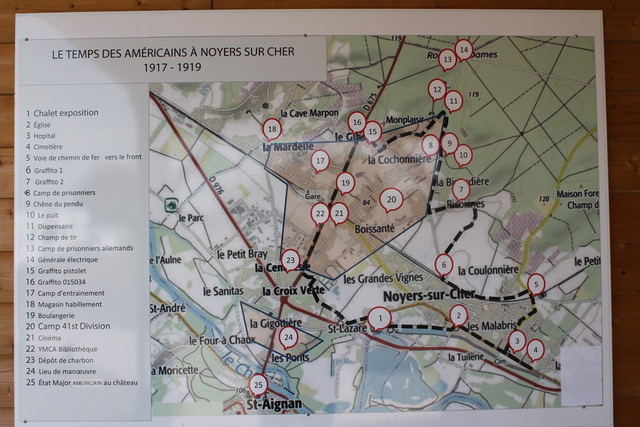
The south of the Loir-et-Cher department was also chosen to become the settlement of the 41st division. In the first days of January 1918, an immense camp made of tents and barracks settled in the meadows of the community of Noyers-sur-Cher. Other camps were built, during the following months in the communities of the whole Cher valley.
The 41st Division, also called the First Depot Division, was in charge to receive and maintain personnel, including classification, training, and assignment of soldiers to replace those wounded or killed in battle. All the Army corps were represented, from artillery to infantry, from elite Marine corps to cavalry, which was based in a former military relay station in Selles-sur-Cher. The methods of training of the 41st Division were excellent and it began the most important depot in the french territory. The other depots imitated its organization methods and training program.
The territory had also several military hospitals at Gièvres, Selles-sur-Cher, Noyers-sur-Cher and Pontlevoy. It is even said that a nurse based in the hospital of Noyers-sur-Cher created the insignia of the 41st division, also called "The Sunset Division."
Monument Text:
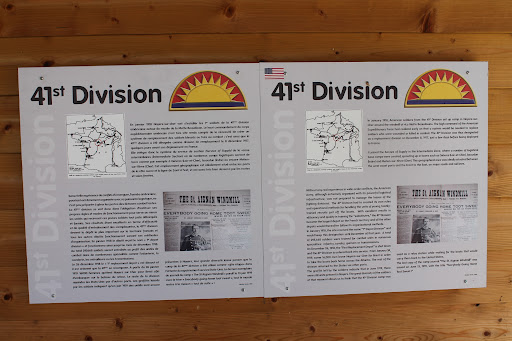
The 41st Divsion sign is written in French and English. The English reads:
(Symbol of the 41st Infantry Division)
In January 1918, American soldiers from the 41st Division set up camp in Noyers-sur-Cher around the windmill at «La Motte Beaudouin». The high command of the American Expeditionary Force had realized early on that a system would be needed to replace soldiers who were wounded or killed in combat. The 41st Division was thus designated as a replacement division on December 8, 1917, just a few days before being deployed
to France. It joined the Service of Supply in the Intermediate Zone, where a number of logistical base camps were created, sprouting up in towns such as Gièvres (Loir-et-Cher), Issoudun (Indre) and Mehun-sur-Yèvre (Cher). This geographical area was ide ally situated between the west coast ports and the Front to the East, on major roads and rail lines.
Without any real experience in wide-scale conflicts, the American Army, although extremely organized with its powerful logistical infrastructure, was not prepared to manage the losses of the fighting divisions. The 41st Division had to created its own rules and operational methods for handling the units of young, hastily-trained recruits just off the boats.
With excellent results in
efficiency and quality in training the "substitutes," the 41* Division became the largest depot on the French territory and all the other depots would thereafter follow its organizational methods.
In January 1918, the site received the name "'" Depot Division" and would keep this designation until December of that year. A total of 295,668 soldiers were trained for combat units in numerous specialties: infantry, cavalry, gunners or transmissions.
On December 26, 1918, the "First Replacement Depot" is shut down and the 41" Division is ordered back into service. From January 24, 1919, some 16,000 men leave Noyers-sur-Cher for Brest in order to take the boats back home across the Atlantic. The rest of the division returned to the States via other ports.
The graffiti left by the soldiers indicate that in June 1919, there were still units present in Noyers. The great diversity of the soldiers at that moment allows us to think that the 41st Division camp was used as a relay station while waiting for the boats that would carry them back to the United States. The last copy of the camp journal "The St. Aignan Windmill" was issued on June 13, 1919, with the title "Everybody Going Home Toot Sweet !"