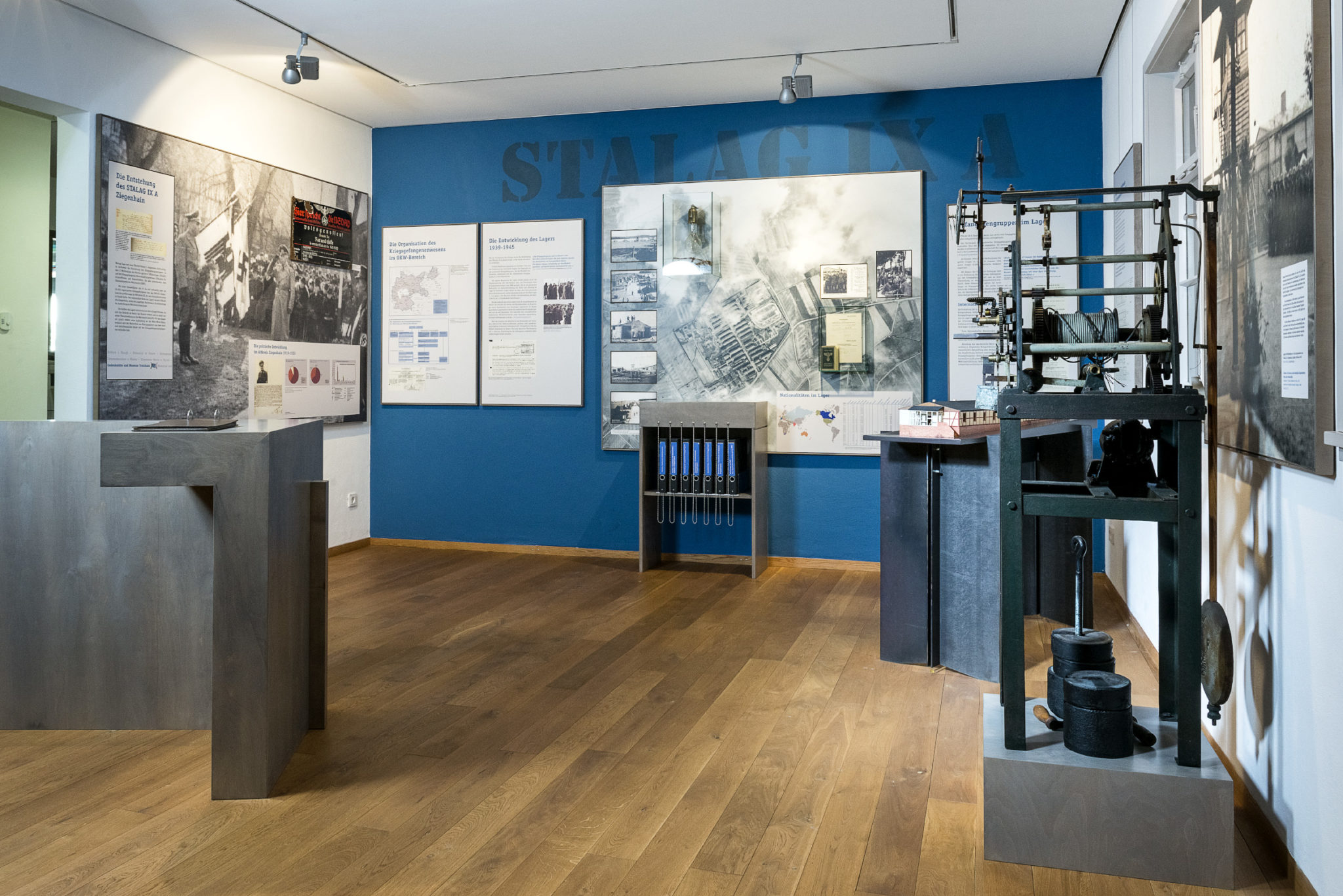






Stalag IX A (Ziegenheim) Camp Museum
Details:
In the former prison location.
MuseumA German national memorial and museum.
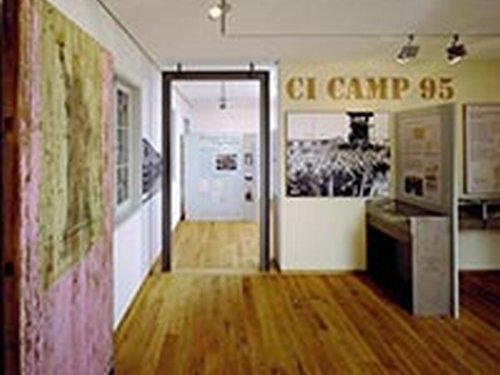
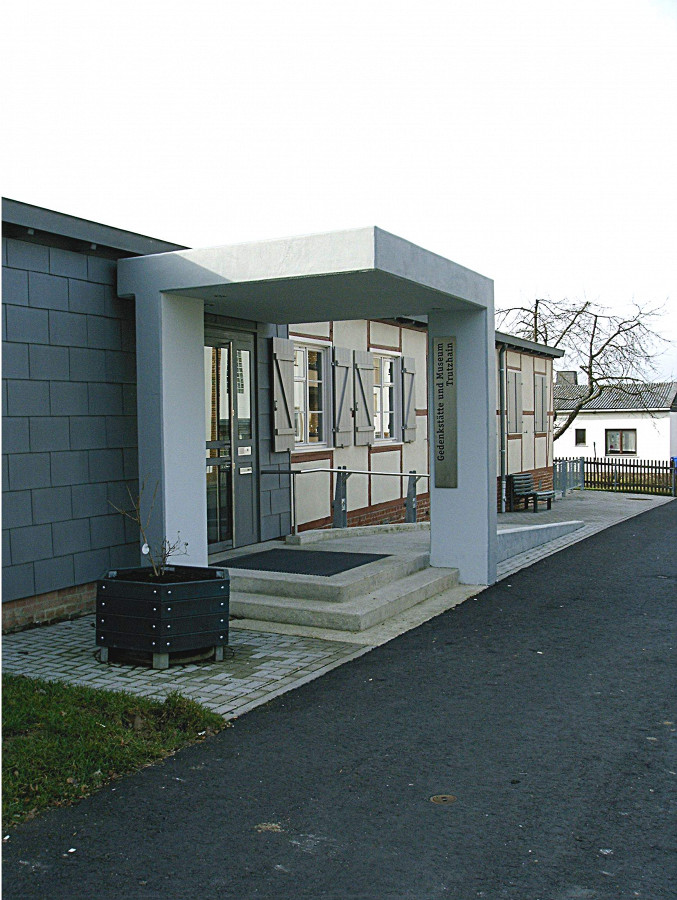
Museum Mission: In 1983, a »Museum for Peace« was established in Trutzhain, which is today a district of Schwalmstadt. It was felt, however, that the exhibition did not present enough information about the history of the various camps located on the premises until 1951. Following a decision of the city council assembly, preparations were made to redesign the exhibition and the historic site at the end of the 1990s. The memorial was opened in 2003 after a new permanent exhibition had been completed. The exhibition presents comprehensive information about the camps once located on the area of the Trutzhain community and about all victim groups. Since 2005, it is possible to follow a historic trail on the large premises of the memorial site, which allows visitors to view the 37 remaining camp barracks that today for the most part serve as residential housing. This includes the former commandant's barracks, the barracks of the Abwehr and guards as well as the infirmary, various workshops and the camp kitchen. The building which today houses the museum was a guard room prior to 1945. For many years it was a residential house, then it stood derelict for a while until it was finally restored to its original condition. The two cemeteries on which the POWs who died in the camp were buried are also part of the memorial site.
Background Information:
Stalag IX A held Belgian, British, French, Soviet, and Serbian prisoners of war (POWs) as well as Italian military prisoners. It was a large camp, with a population of more than 35,000 throughout most of the war and a maximum population of 53,408 prisoners in September 1944. However, most of the prisoners registered in the main camp did not live there but were instead deployed in the numerous work details (Arbeitskommandos) in the area surrounding the camp.3 Many of the prisoners were employed in the arms industry in Kassel, in violation of the Geneva Conventions prohibition on the use of prisoner labor for war-related work.
On January 26, 1945, a group of 1,292 American noncom-missioned officers arrived at Stalag IX A from Stalag IX B in Wegscheide, near Bad Orb mostly captured during the "Battle of the Bulge". The following day, the camp commandant ordered all of the American Jewish prisoners to line up in front of their barracks. Fearing that these prisoners were going to be executed, the highest-ranking American officer in the camp, Master Sergeant Roddie Edmonds, ordered all of the American prisoners, Jewish or non-Jewish to line up outside the barracks. When the commandant demanded that Edmonds give up the names of the Jewish prisoners, he informed the commandant that we [the Americans] are all Jews here and repeated this statement even after the commandant put his pistol to Edmondss head and threatened to shoot him. In the end, none of the approximately 200 American Jewish prisoners was harmed in this incident. In 2015, 30 years after his death, Master Sergeant Edmonds was recognized by Yad Vashem as one of the Righteous Among the Nations. He is one of only five Americans to receive the honor and the only American soldier recognized as such; his citation is also the only one awarded for saving the lives of American Jews. Edmonds was awarded the Congressional Medal of Honow, posthumously, in 2026.
Stalag IX A was liberated by the American 6th Armored Division on March 30, 1945.
Source of Information: https://www.memorialmuseums.org/memorialmuseum/gedenkstatte-und-museum-trutzhain
https://muse.jhu.edu/document/4714
Monument Text:
Commemorates:
People:
Rodrick Waring 'Roddie' Edmonds
Units:
106th Infantry Division
3rd US Army
6th Armored Division
United States Army
Wars:
WWII
Battles:
Holocaust Camp Liberation
Other images :