





Hiroshima-Nagasaki Victims Monument
Details:
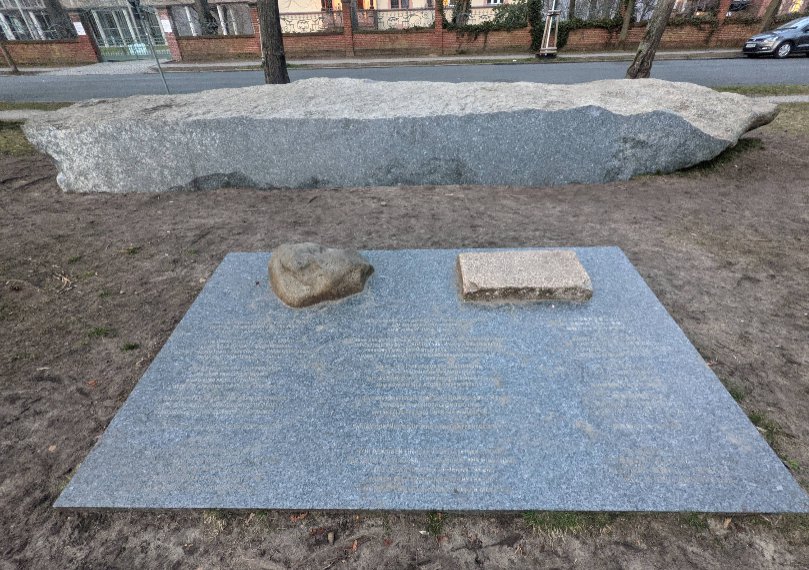
Embedded in the ground near a bench within the square.
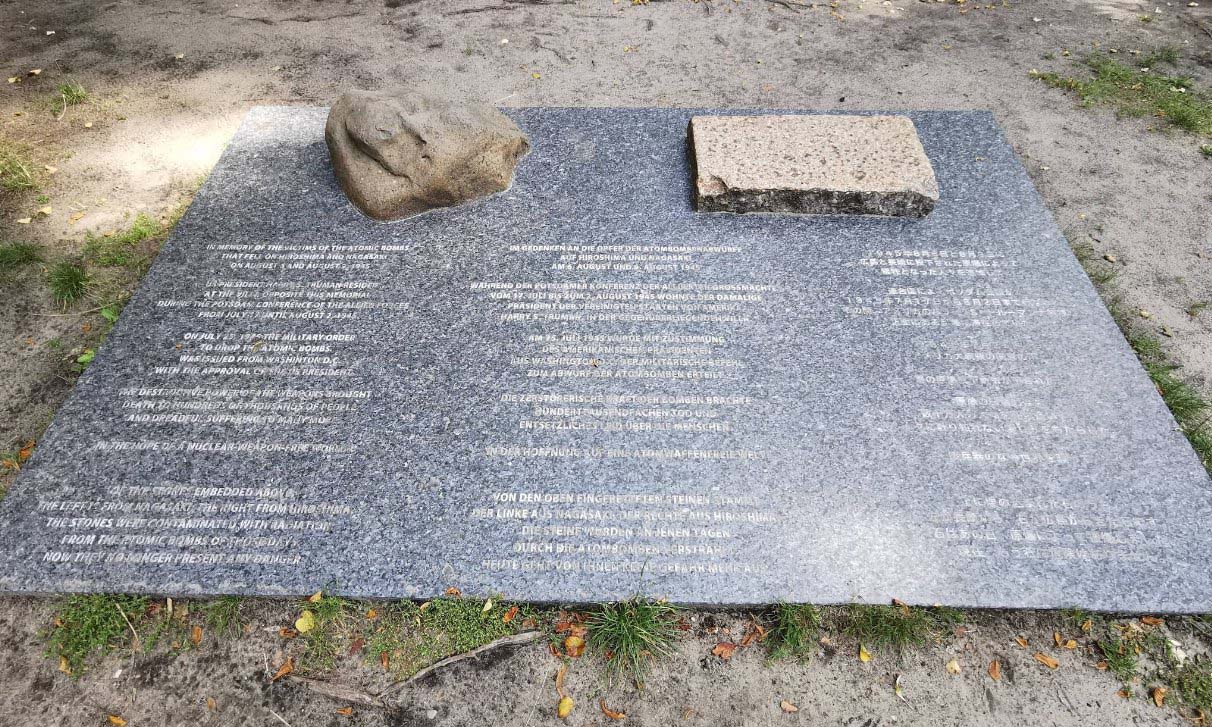
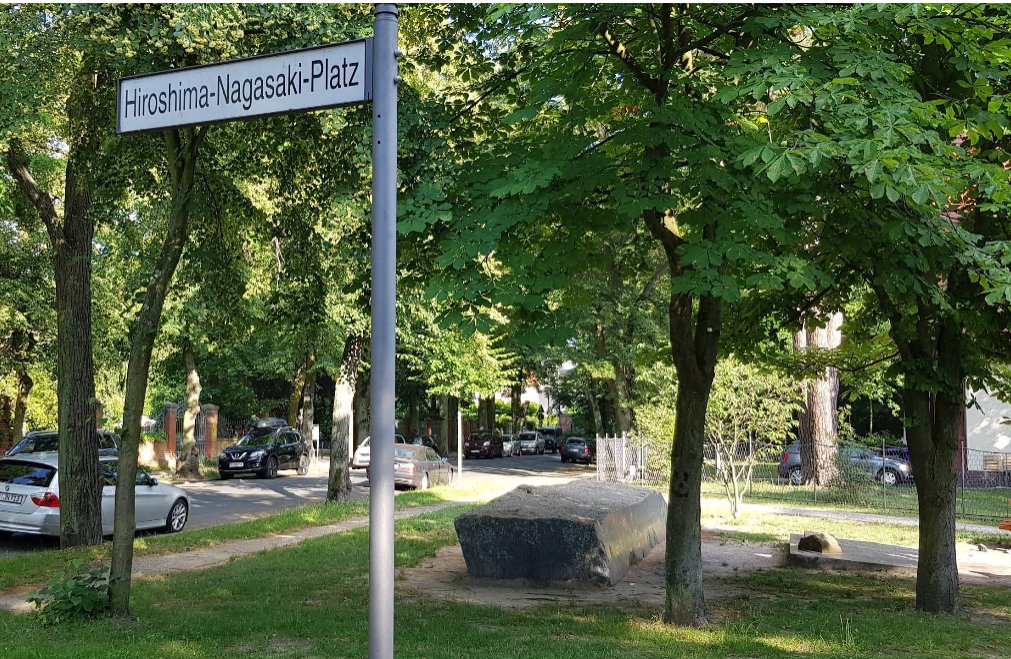
MonumentThe monument consists of two memorial stones, both carved from Norwegian Syenite. One nine-meter-long 3.6-ton horizontal stone symbolizes an Altar of Remembrance, with its weight and size highlighting its great importance and inner power. A stone slab measuring 2.86 meters by 1.83 meters includes inscriptions in English, German, and Japanese languages and is embedded with stones initially contaminated by atomic bomb blasts in Hiroshima and Nagasaki. The stone from Hiroshima (at the right side) came from a support to a streetcar track there, and that from Nagasaki (at the left side) was from the Shinto shrine Sann, about 800 meters from ground zero there - neither poses any radioactivity hazard now.
The monument is situated across the street from the so-called Truman House (now headquarters of the international organization Friedrich Naumann Foundation for Freedom), where U.S. President Harry S. Truman lived while participating in the Potsdam Conference at the end of World War II.
At that house on 25 July 1945, President Truman reportedly decided to employ atomic bombs on Hiroshima and Nagasaki and force an end to the War with Japan. Both cities were leveled by the strikes, and this forced the Japanese Emperor, without his Cabinets consent, to decide on unconditional surrender to end the Pacific war on 10 August 1945.
The main initiators and coordinators for this memorial were the organization Hiroshima-Platz e.V. and Professor Doctor Hideto Sotobayashi, an eyewitness to the atomic blast in Nagasaki. Japanese artist Professor Makoto Fujiwara designed the memorial, and student artists from an exchange program between Hiroshima State University and Hannover University of Applied Sciences helped create it, supported by donations from Germany and primarily Hiroshima in Japan.
The complete monument and square where it is located were dedicated on 25 July 2010, on the 65th anniversary of Trumans decision to conduct atomic strikes on Hiroshima and Nagasaki at the end of World War II.
Source of information: hiroshima-nagasaki-platz.de, www.potsdam-wiki.de, www.atlasobscura.com
Monument Text:
First column text:
IN MEMORY OF THE VICTIMS OF THE ATOMIC BOMBS
THAT FELL ON HIROSHIMA AND NAGASAKI ON
AUGUST 6 AND AUGUST 9, 1945.
U.S. PRESIDENT HARRY S. TRUMAN RESIDED AT THE
VILLA OPPOSITE THIS MEMORIAL DURING THE
POTSDAM CONFERENCE OF THE ALLIED FORCES
FROM JULY 17 UNTIL AUGUST 2, 1945.
ON JULY 25, 1945 THE MILITARY ORDER TO DROP THE
ATOMIC BOMBS WAS ISSUED FROM WASHINGTON
D.C. WITH THE APPROVAL OF THE U.S. PRESIDENT.
THE DESTRUCTIVE POWER OF THE WEAPONS
BROUGHT DEATH TO HUNDREDS OF THOUSANDS OF
PEOPLE AND DREADFUL SUFFERING TO MANY
MORE.
IN THE HOPE OF A NUCLEAR WEAPONS-FREE
WORLD.
OF THE STONES EMBEDDED ABOVE, THE LEFT IS
FROM NAGASAKI, THE RIGHT FROM HIROSHIMA. THE
STONES WERE CONTAMINATED WITH RADIATION
FROM THE ATOMIC BOMBS OF THOSE DAYS. NOW
THEY NO LONGER PRESENT ANY DANGER.
Second column text:
ZUM GEDENKEN AN DIE OPFER DER
ATOMBOMBENABWÜRFE AUF HIROSHIMA UND
NAGASAKI AM 6. AUGUST UND 9. AUGUST 1945
WÄHREND DEN POTSDAMER KONFERENZE DER
ALLIERTEN GROSSMÄCHTE VOM 17. JULI BIS ZUM 2.
AUGUST 1945 WOHNTE DER DAMALIGE PRÄSIDENT
DER VEREINIGTEN STAATEN VON AMERIKA HARRY S.
TRUMAN IN DER GEGENÜBERLIEGENDEN VILLA.
AM 25. JULI 1945 WURDE DIE MIT ZUSTIMMUNG DES
AMERIKANISCHEN PRÄSIDENTEN AUS WASHINGTON
D.C. DER MILITÄRISCHE BEFEHL ZUM ABWURF DER
ATOMBOMBEN ERTEILT.
DIE ZERSTÖRERISCHE KRAFT DER BOMBEN
BRACHTE HUNDERTTAUSENDFACHEN TOD UND
ENTSETZLICHES LEID UBER DIE MENSCHEN
IN DER HOFNUNG AUF EINE ATOMWAFFENFREIE
WELT
VON DEN OBEN EINGEBETTETEN STEINEN STAMM
DER LINKE AUS NAGASAKI, DER RECHTE AUS
HIROSHIMA. DIE STEINE WURDEN AN JENEN TAGE
DURCH DIE ATOMBOMBEN VERSTRAHLT. HEUTE
GEHT VON IHNEN KEINE GEFAHR MEHR.
Third column text:
( written in Japanese )
Commemorates:
People:
Units:
United States Army
Wars:
WWII
Battles:
Pacific Theater
Other images :