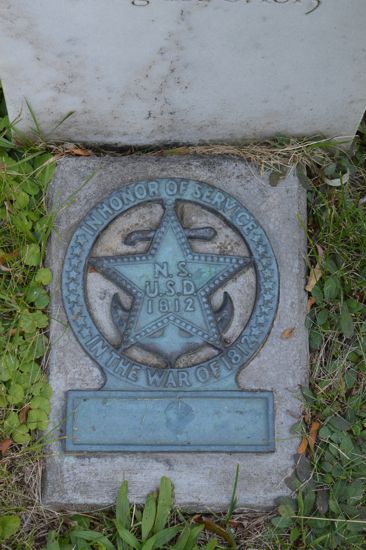






USS Hamilton & USS Scourge War of 1812 Memorial Markers
Details:
In the park adjacent ot the Cenotaphs of the ships'crew.
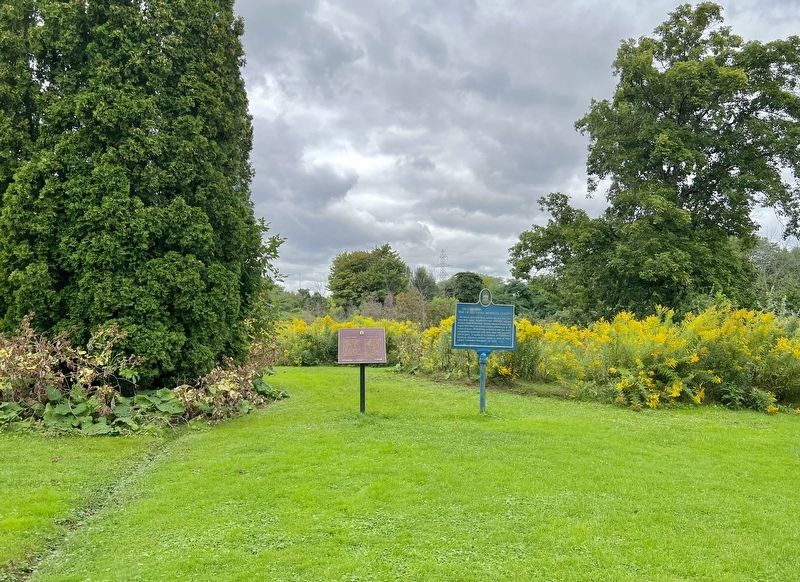
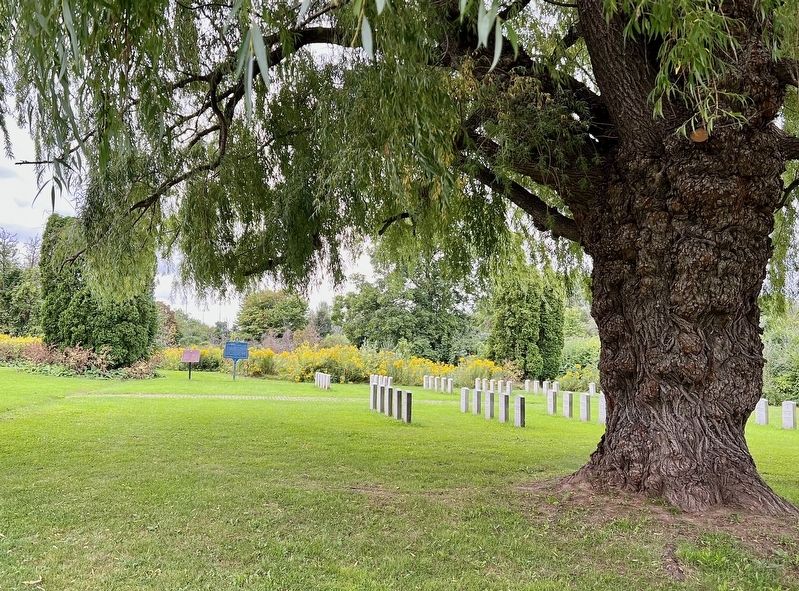
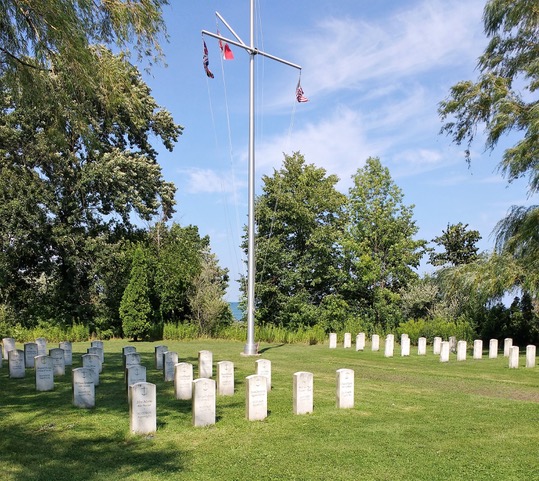
MarkerThree Canada Historical Markers and information signs. The grave area includes 53 Cenotaphs with a replica of the main mast of the USS Hamilton in the center.
The markers and signs remember the USS Hamilton and USS Scourge which snak near here in 1813 and a nearby memorial includes 53 cenoptaphs to the crew who persihed.
On 8 August 1813, two American naval schooners, USS Hamilton and USS Scourge, sank in a violent and sudden squall on Lake Ontario, off the shoreline near present-day St. Catharines.
Eight men survived from each of the ships, but 53 men lost their lives when both went down around 2am.
Both ships had originally been merchant schooners; the Hamilton had originally been an American ship called the 'Diana' that was bought by the US Navy; and the Scourge had been a British ship called 'The Lord Nelson' that was seized by American authorities in 1812 on suspicion of being involved in smuggling. Both were converted into US Navy vessels when war broke out.
In 1973, an expedition was launched to find the schooners, with a suspected location identified in 300 feet of water approximately 10.5 kilometres northwest of the lighthouse at Port Weller near St. Catharines, Ontario.
The wreck site has been designated a National Historic Site and an amendment to the Ontario Heritage Act in 2005 gives the site special protection as the wrecks contain human remains.
Source of information and photos: https://militarybruce.com/memorial-to-two-lost-war-of-1812-schooners-on-hamiltons-waterfront/
https://www.hmdb.org
https://hamiltonnaval.ca/h-m-c-s-star/war-of-1812/uss-hamilton-scourge/
https://www.pc.gc.ca/apps/dfhd/page_nhs_eng.aspx?id=411&i=65226
Monument Text:
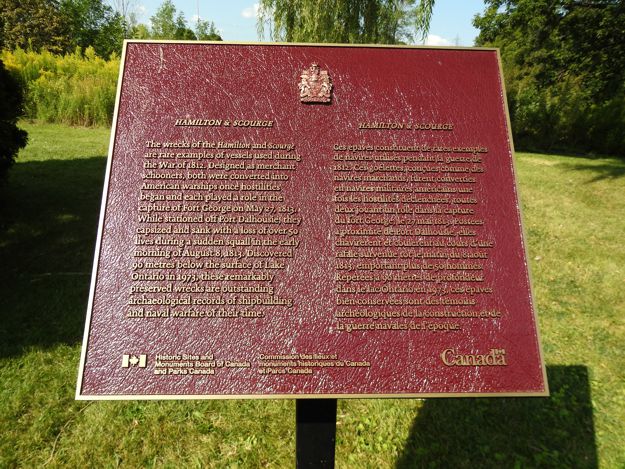
USS Hamiliton and USS Scourge Canada Historical Marker (English and French):
Hamilton & Scourge
The wrecks of the Hamilton and Scourge are rare examples of vessels used during the War of 1812. Designed as merchant schooners, both were converted into American warships once hostilities began and each played a role in the capture of Fort George on May 27, 1813. While stationed off Port Dalhousie, they capsized and sank with a loss of over 50 lives during a sudden squall in the early morning of August 8, 1813. Discovered 90 metres below the surface of Lake Ontario in 1973, these remarkably preserved wrecks are outstanding archaeological records of shipbuilding and naval warfare of their time.
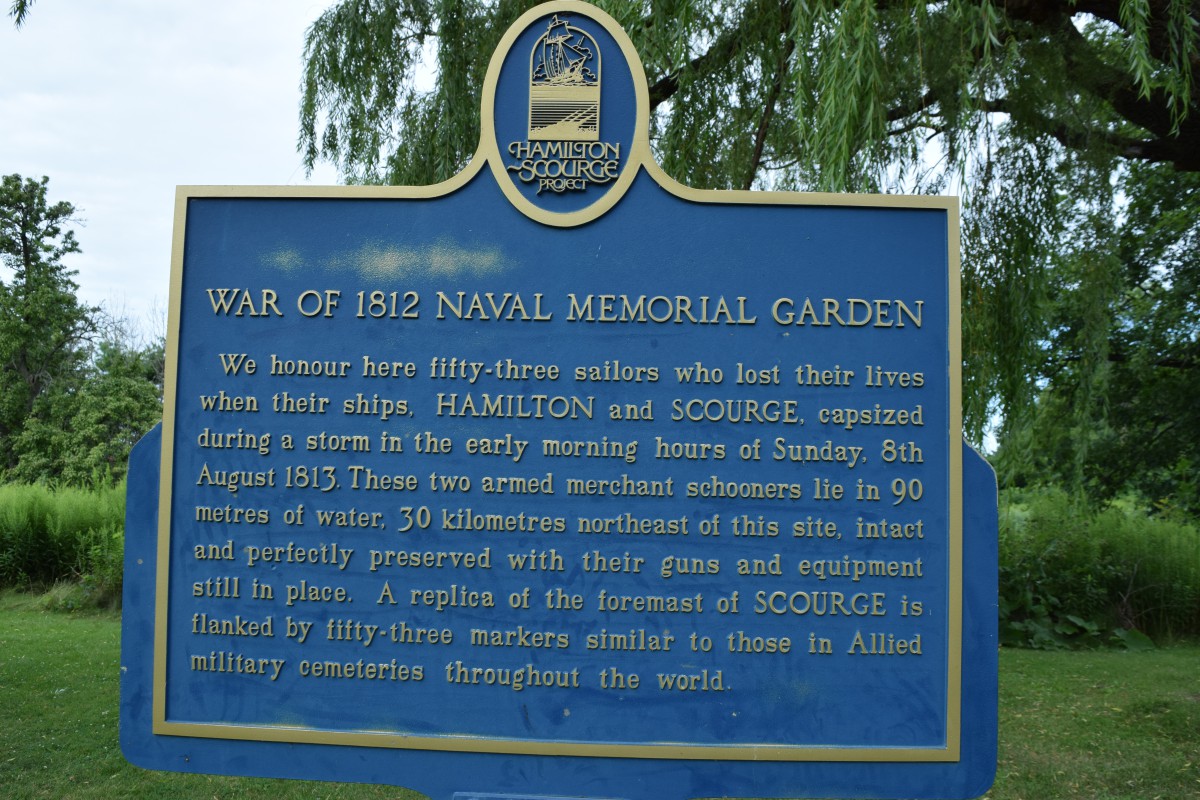
War of 1812 Naval Memorial Garden Marker (English):
We honour here fifty-three sailors who lost their lives when their ships, HAMILTON and SCOURGE, capsized during a storm in the early morning hours of Sunday, 8th August 1813. These two armed merchant schooners lie in 90 metres of water, 30 kilometres northeast of this site, intact and perfectly preserved with their guns and equipment still in place. A replica of the foremast of SCOURGE is flanked by fifty-three markers similar to those in Allied military cemeteries throughout the world.
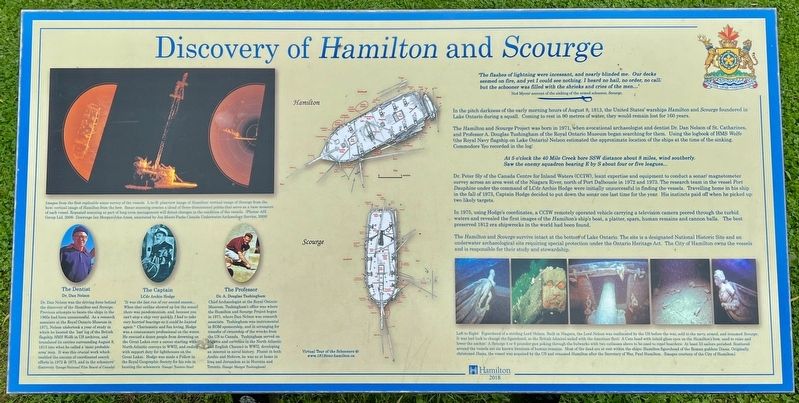
Discovery of Hamilton and Scourge Information Sign (English):
The flashes of lightning were incessant, and nearly blinded me. Our decks seemed on fire, and yet I could see nothing. I heard no hail, no order, no call; but the schooner was filled with the shrieks and cries of the men...
Ned Myers' account of the sinking of the armed schooner, Scourge.
In the pitch darkness of the early morning hours of August 8, 1813, the United States' warships Hamilton and Scourge foundered in Lake Ontario during a squall. Coming to rest in 90 metres of water, they would remain lost for 160 years.
The Hamilton and Scourge Project was born in 1971, when avocational archaeologist and dentist Dr. Dan Nelson of St. Catharines, and Professor A. Douglas Tushingham of the Royal Ontario Museum began searching for them. Using the logbook of HMS Wolfe (the Royal Navy flagship on Lake Ontario) Nelson estimated the approximate location of the ships at the time of the sinking.
Commodore Yeo recorded in the log:
At 5 o'clock the 40 Mile Creek bore SSW distance about 8 miles, wind southerly. Saw the enemy squadron bearing E by S about four or five leagues...
Dr. Peter Sly of the Canada Centre for Inland Waters (CCIW), leant expertise and equipment to conduct a sonar/magnetometer survey across an area west of the Niagara River, north of Port Dalhousie in 1972 and 1973. The research team in the vessel Port Dauphine under the command of LCdr Archie Hodge were initially unsuccessful in finding the vessels. Travelling home in his ship in the fall of 1973, Captain Hodge decided to put down the sonar one last time for the year. His instincts paid off when he picked up two likely targets.
In 1975, using Hodge's coordinates, a CCIW remotely operated vehicle carrying a television camera peered through the turbid waters and revealed the first images of the Hamilton's ship's boat, a platter, spars, human remains and cannon balls. The best preserved 1812 era shipwrecks in the world had been found.
The Hamilton and Scourge survive intact at the bottom of Lake Ontario. The site is a designated National Historic Site and an underwater archaeological site requiring special protection under the Ontario Heritage Act. The City of Hamilton owns the vessels and is responsible for their study and stewardship.
The Dentist
Dr. Dan Nelson
Dr. Dan Nelson was the driving force behind the discovery of the Hamilton and Scourge.
Previous attempts to locate the ships in the 1960s had been unsuccessful. As a research associate at the Roval Ontario Museum in 1971, Nelson undertook a year of study in which he located the 'lost' log of the British flagship HMS Wolfe in US archives, and translated its entries surrounding August 8, 1813 into what he called a 'most probable area' map. It was this crucial work which enabled the success of coordinated search efforts in 1972 & 1973, and in the schooners' discovery. (Image: National Film Board of Canada)
The Captain
LCdr Archie Hodge
"It was the last run of our second season... When that outline showed up [on the sonar] there was pandemonium, and, because you can't stop a ship very quickly, I had to take very hurried bearings so it could be located again." Charismatic and fun loving, Hodge was a consummate professional on the water. He rescued a dozen people from drowning on the Great Lakes over a career starting with North Atlantic convoys in WWII, and ending with support duty for lighthouses on the Great Lakes. Hodge was made a Fellow in the Royal Geographic Society for his role in locating the schooners.
The Professor
Dr. A. Douglas Tushingham
Chief Archaeologist at the Royal Ontario Museum. Tushingham's office was where the Hamilton and Scourge Project began in 1971, where Dan Nelson was research associate.
Discovery of Hamilton and Scourge marker detail (top left) image.
4. Discovery of Hamilton and Scourge marker detail (top left)
Tushingham was instrumental in ROM sponsorship, and in arranging for transfer of ownership of the wrecks from the US to Canada. Tushingham served on frigates and corvettes in the North Atlantic and English Channel in WWII, developing an interest in naval history. Fluent in both Arabic and Hebrew, he was as at home in Iraq and Jerusalem as in Huronia and Toronto.
Erected 2018 by City of Hamilton.
Commemorates:
People:
Units:
U.S.S. Hamilton
U.S.S. Scourge
United States Navy
Wars:
War of 1812
Other images :