





US Army Demarkation Line Outpost - WW2, 3rd US Army
Details:
In an open field at the Y in the road.
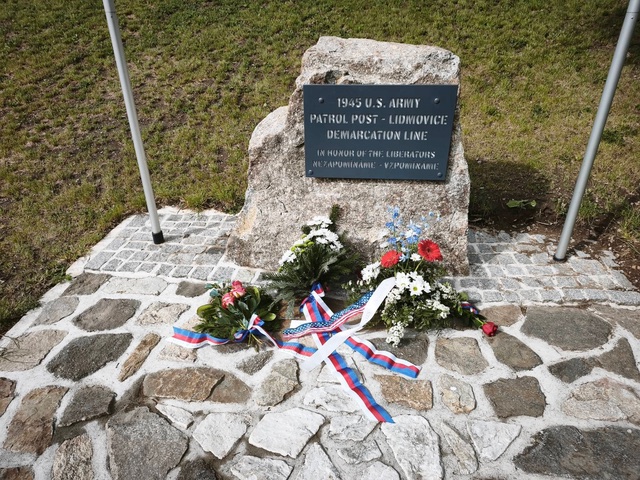
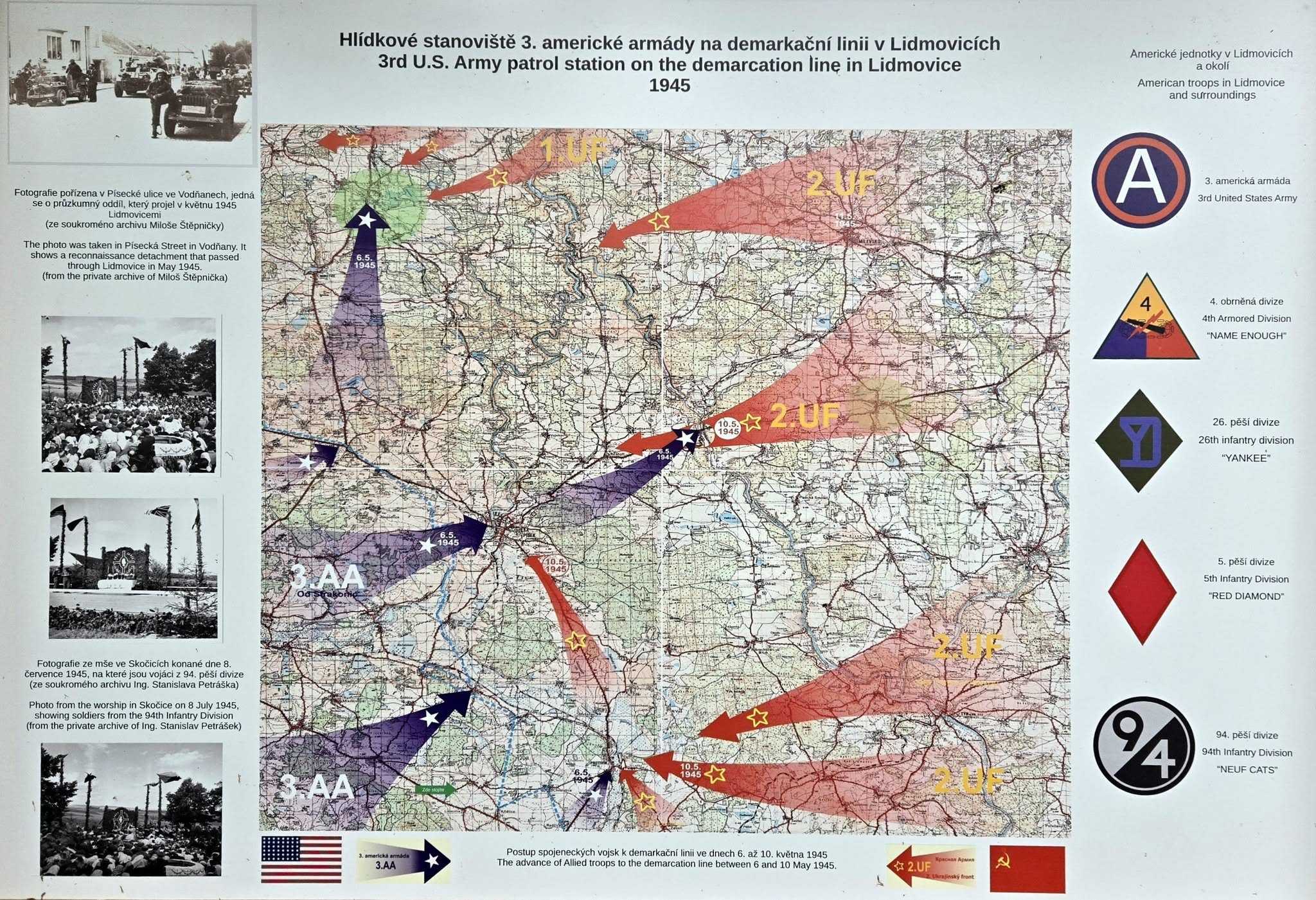
MonumentA stone monument with an inscribed plaque attached to the front; an information board explains the situation at the end of the war and the link-up of US and Soviet Forces.
The memorial remembers a US Army outpost at this location on the demarkation line between US and Soviet Forces form May to July 1945 at the end of WW2.
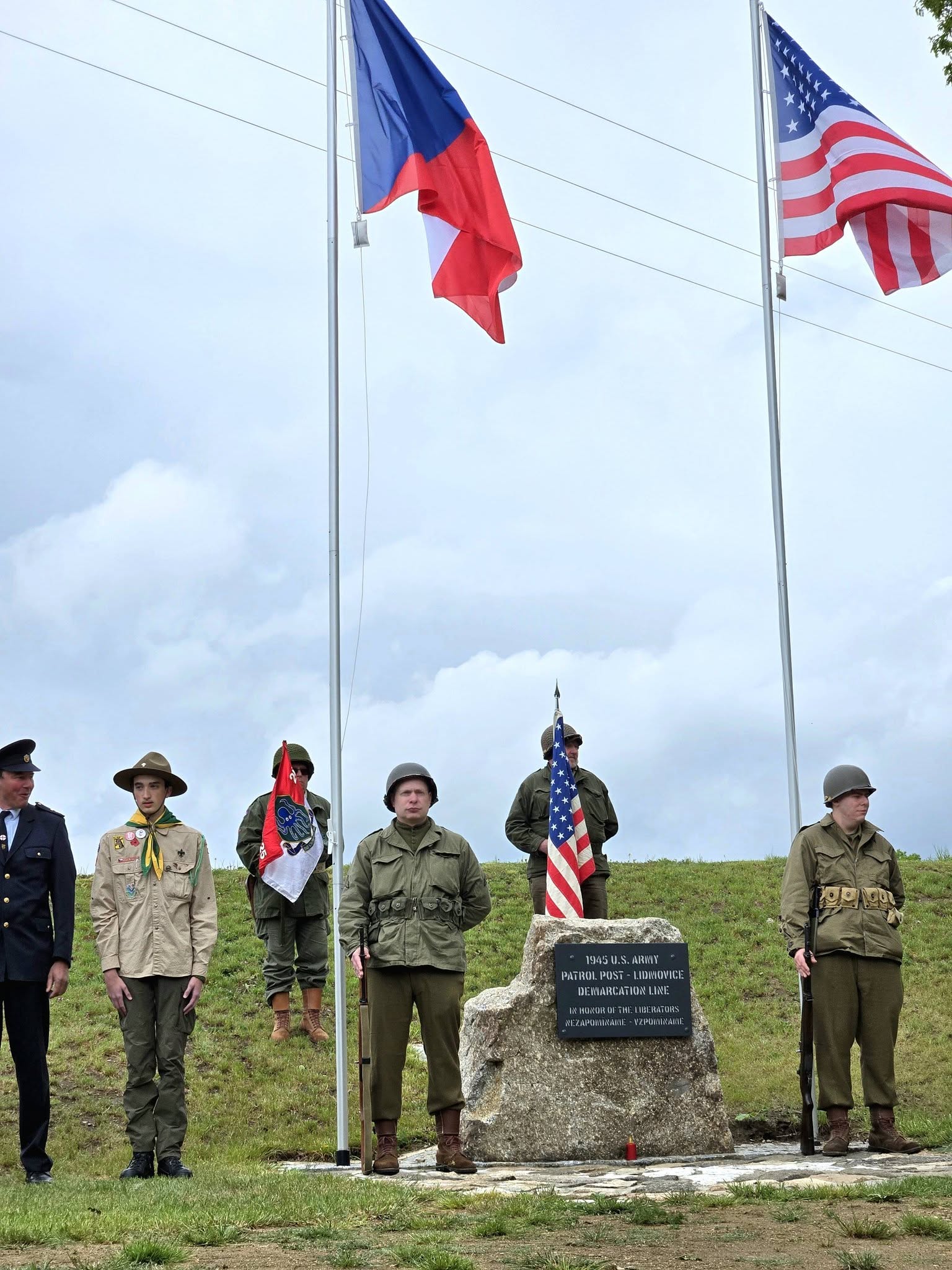
The memorial was dedicated in 2025.
Source of information and photos: Buddies of the 4th Armored Division - Pisek; Website: https://buddies-pisek.cz
Monument Text:
The monument plaque reads:
1945 U.S. ARMY
PATROL POST - LIDMOVICE
DEMARCATION LINE
IN HONOR OF THE LIBERATORS
NEZAPOMINAME - VZPONINAME
The information sign reads:
Forgotten Liberation and the Memory of Totalitarianism
Dear readers of this information board, you are standing at the site where, from May 12 to the end of August 1945, a checkpoint of the demarcation line was manned by a unit of the U.S. 3rd Army. Due to the events that took place between 1948 and 1989 in then-Czechoslovakia, it was not possible to commemorate the liberation of part of our country by the American army. The totalitarian communist dictatorship strictly prohibited and punished any attempt to remember this historical fact - the regime aimed to erase this chapter of history from collective memory. In memory of these events and to right this wrong, this information board and memorial were created to bring attention to the nearly forgotten history of the 1945 liberation in this region.
May 1945 - The End of the War in Sight
It was 1945, and World War Il had been raging for six years. Allied bombing raids intensified, and the Western Front rapidly advanced - the Americans and British from the west, the Soviets from the east. The end of Nazi Germany was near.
As May began, large numbers of motorized German units retreated westward through Lidmovice and the surrounding area. A small partisan group formed in Lidmovice, though its significance was mostly symbolic. Locals erected a triumphal arch - a gate of freedom - on the main road bridge. On May 6, the first American reconnaissance unit arrived through this arch from Strakonice.
First Contact with Patton's Army
Consisted of soldiers from the 25th Cavalry Reconnaissance Squadron, Troop A. These were soldiers of the 3rd U.S. Army, commanded by Lieutenant General George S. Patton - specifically units of the XII Corps under Major General Stafford L. Irwin, the 4th Armored Division led by Major General William M. Hoge, and Combat Command A (CCA) commanded by Colonel Hayden A. Sears. The detachment Four jeeps with additional armor - each equipped with a machine gun - arrived in the village. Two vehicles carried .30 caliber machine guns, the other two had .50 caliber ones. An M8 Greyhound armored car accompanied the column. The convoy continued toward Vodñany, later returning in the direction of Strakonice.
Technology Never Seen Before
On May 7, another unit arrived from Strakonice - the 24th Armored Engineer Battalion of the 4th Armored Division. This battalion later worked on the road between Kittice and Chvaletice. It carried an impressive array of equipment: bulldozers, excavators, graders, scrapers, GMC dump trucks, and a generator.
The 4th Armored Division was considered elite among the American units operating in Bohemia. At 6:00 AM on May 6, it launched an attack toward Vimperk, Volyne, and Strakonice. Progress was slowed by muddy roads, rain, fog, and enemy resistance. Also advancing in the same direction was the 5th Infantry Division under Major General Albert E. Brown, initially securing mountain passes and later covering the right flank of the 4th Armored Division. The 4th Armored Division reached Strakonice at 3:00 PM (summer time), and the next day expanded its bridgehead to the line Písek-Sedlice.
Arrival of the Allies in Drahonice and Lidmovice
On May 8 at 6:00 PM, the 4th Armored Division stationed troops in Drahonice. Ten M8 Greyhounds and several armored jeeps with machine guns arrived. Reportedly, three American soldiers spoke Czech. A reconnaissance unit passed through Skocice, Lidmovice, and Vodñany, then returned and continued toward Drahonice.
The Soviets Arrive - On Foot and by Wagon
On May 9, the Americans passed through again - at 3:00 PM and 7:30 PM - this time with a larger unit from the 26th Infantry Division under Major General Willard Stewart Paul. The column included several GMC trucks and a jeep.
The arrival of the Soviets was expected. They came only on the evening of May 10 - on foot or in horse-drawn wagons, carrying a Maxim machine gun from World War I. According to eyewitnesses, they were very tired after marching from Ceské Budejovice. They entered territory already controlled by the Americans. Thus, on May 12, Major General Brown and Brigadier General Alan D. Warnock arrived in Vodñany to meet with Major Generals Tikhonov and Masovchuk. Colonel Sucharda represented the Czechoslovak side. The demarcation line was agreed upon at the town savings bank and confirmed by signatures at the National.
Friendly Americans, Helpless Soviets
The Soviets were poorly supplied. They walked around the village begging for food and took horses without permission. They even fired into the village pond - ossibly trying to catch fish. At one point, they asked for vodka - a farmer brought them a bucket of water, only then realizing they meant alcohol Vhen asked about their professions. they replied "teacher." "endineer" - it was later revealed most were illiterate. They admired local farms. machinery. anc homesteads - things they had never seen before.
American Demarcation Post
On May 12, the Americans established a demarcation checkpoint in Lidmovice. The road toward Pohorovice was closed with a barrier guarded by a soldier. The post consisted of about ten men; the tent held beds, supplies, and a telephone line connected to the school in Skocice, whose upper floor served as headquarters.
Each morning, exercises were held on the school playground. M1 Garand rifles were stacked in a cone formation. For using the school, the Americans paid the village 94,180 Czechoslovak crowns.
Daily Routine, Jeep with a Dog and Guitar
A jeep from Skoice brought daily supplies, mail, medicine, and ammunition. The Americans had excellent logistics - including canned food and drinks like coffee and juice. In Vodñany, they treated people rescued from concentration camps with penicillin, which was not available in Czechoslovakia.
Some locals also helped. Mrs. Kulhová from Lidmovice did laundry and ironing for the soldiers and was paid. The jeep driver brought a small dog that would rest its paws on the steering wheel, looking as if it were driving.
One witness remembers a race between two GMC trucks from Skocice to Lidmovice. One truck had to brake sharply to avoid a horse cart coming from the opposite direction, where the witness then a small boy - sat with his uncle on the way to a meadow. The wind from the passing trucks blew the uncle's hat off his head. Another recalled an American soldier playing the guitar - then an unfamiliar instrument in Czechoslovakia. He thought how musically behind the country was. Twenty years later, the guitar became a popular instrument here. The soldiers amused themselves by throwing bayonets at a barn door, or by playing unfamiliar sports with an oval ball or with a bat, ball, and glove. Shooting at cans with captured pistols was a favorite game. They were good shots - hitting the can again as it moved.
The Americans were friendly. They gave chocolate, nuts, and oranges to children. Farmers brought them eggs in return - a sought-after item despite their excellent rations. One eight-year-old boy rode to visit the Americans on a bicycle. One soldier borrowed the bike and rode into the village, returning later to give it back. As a thank-you, he handed the boy a pistol to shoot a can. Another soldier, considering it dangerous, quickly confiscated the gun. The witness is still amazed that his child-sized bike could carry an American soldier.
Kocanda, Chicago, and the War with Japan
Two young soldiers, aged 18 and 19, stayed with the Klas family at Kocanda. Mrs. Klas had lived for eight years in Chicago, which is why she spoke fluent English.
Her eleven-year-old daughter cooked for them, and they liked the food so much they joked about taking her to America. Later, Mrs. Klas wrote to check how they were doing. Sadly, the reply informed her that both young men had died fighting Japan. At the end of June, local soldiers of the XII Corps were deployed to the Pacific to fight the Japanese. They were replaced by the XXII Corps under Major General Ernest N. Harmon, the 94th Division under Major General Allison J. Barnett, and the Vodñany garrison led by Brigadier General B. G. Hodges and an infantry major.
Prisoner Camp and Deportation
By agreement with the Soviets, the Americans established a temporary POW camp near pond Jordán under Skocice, monitored by the Red Army. German families and surrendered soldiers were transported around the clock for 14 days by American GMC trucks from the Strakonice direction and handed over to the Soviets. Prisoners left their belongings at the camp and, after reaching a certain number, were walked to the brewery cellars in Protivín and then transported to the Soviet Union. Some Germans attempted to escape - some succeeded. One witness recalled that some used reeds as makeshift snorkels and swam the entire pond underwater. Others were shot during their escape.Another eyewitness described how, after being shot, one escapee collapsed, and a Soviet soldier jumped on his chest until he died. Witnesses often commented on how war changed people. These executed prisoners were buried under the camp. After completing the two-week transport, the Soviets withdrew toward Protivín.
Final Farewell
On July 8, a pilgrimage mass was held in Skoice with strong attendance, including American soldiers from Lidmovice. Several photographs remain showing soldiers of the 94th Division. By the end of August 1945, the Americans left Lidmovice permanently. Due to the rise of the totalitarian regime and developments in the Pacific, they never returned.
In Vodñany, American soldiers stayed until December 1, 1945. In 1995, some returned to celebrate the 50th anniversary of liberation.
Patton's Legacy
The U.S. 3rd Army demonstrated modern and effective warfare using state-of-the-art equipment on our territory. This fulfilled the quote by General George S. Patton:
"No one ever won a war by dying for his country. He won it by making the other poor dumb bastard die for his."
Sources: Municipal and school chronicles from Skocice, Drahonice, Strakonice, Bavorov, Vodnany, Protivín, Strunkovice nad Blanici, Volyne, Volary, Vlachovo Brezi and Netolice; Sokol Chronicle Vodnany; Skocice Parish Chronicle; Memorial Book of Prachatice; Proceedings and Documents of the 50th Anniversary of the Republic's Liberation - Vodnany 1937-1945; Vodnany City Museum and Gallery; Museum of the Central Otava Region; State District Archives Pisek and Strakonice:Prächen Museum in Pisek; Information Center Bavorov; eyewitness accounts - Karel Kristan Sr., Vladimir Hronek Sr., Vaclav Kuberna, Marie Tlustosov, Vaclav Krejcí, Vera Krejcová, Vojtch Hosek; book by Vladimír Kos - May 1945 in South Bohemia; historical photos; additional information provided by - Tomás Nohejl,Frantisek Nachlinger, Radek Kuncipal; Chronology of the Liberation of Western Bohemia.
The initiator of the monument was Karel Kristan.
The following people participated in the realization of the memorial: SDH Lidmovice, BUDDIES club of the 4th Armored Division Písek, Jaroslav Suhrada, Karel
Kuncipál, Marek Soul and the mayor of the village Ing. Jan Sídlo.
The memorial was unveiled on 9th July 2025.
Source: https://buddies--pisek-cz.
Commemorates:
People:
William Morris “Bill” Sr. Hoge
Units:
24th Armored Engineer Battalion, 4th Armored Division
25th Reconnaissance Squadron, 4th Armored Division
26th Infantry Division
3rd US Army
4th Armored Division
5th Infantry Division
94th Infantry Division
Combat Command A, 4th Armored Division
Soviet Military Forces
XII Corps
Wars:
WWII
Other images :