





Lt Joseph Kennedy & Lt Wilford Willy Operation Anvil Plane Explosion Plaque
Details:
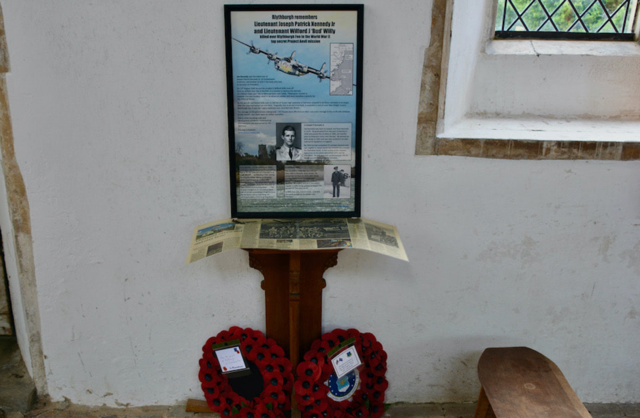
On a display inside the church.
Plaque
A framed informational sign.
The memorial remembers
Background:
Codenamed Aphrodite by the USAAF, and Anvil by the Navy, they were two secret operations running side by side. The idea behind these operations, was to remove all excess equipment from war-weary B-17s and B-24s, fill them with explosives, such as the British Torpex, put in radio receivers so that the drone (baby) could be controlled by a separate aircraft (mother) and fly them into designated targets. A volunteer crew of two would take off, set the aircraft in flight and then bail out over the U.K. or English Channel, leaving the baby in the control of the mother aircraft. These would then fly, by remote control, to the target when they would be put into a dive destroying whatever they hit.
At RAF Fersfield, on August 12th 1944, Lieutenants Joseph Kennedy Jnr. and Wilford J. Willy, both of the S.A.U. 1 of the Fleet Air Arm Wing Seven, boarded their converted B-24 Liberator, s/n 32271 (ex USAAF B-24J 42-110007)*2 and began their preflight checks. The aircraft was filled with 21,270lbs of explosive. At 17:55 and 17:56 two Lockheed Ventura mother aircraft took off, followed by a further navigation aircraft and then the baby at 18:07. The baby climbed to 2,000 ft, the two mothers 200 feet higher and slightly behind. They were joined by two Mosquitoes, one for monitoring the weather, and the second, a USAAF F-8, to photograph the baby. This aircraft was flown by pilot Lieutenant Robert A. Tunnel and combat camera man Lieutenant David J. McCarthy. There was a further B-17 relay ship, a P-38 high altitude photo reconnaissance aircraft and five P-51 Mustangs to provide fighter cover.
The group set off toward the target at Mimoyecques , Northern France. They were to fly south-east toward the Suffolk coast, then turn south and head toward the target. Once level and stabilised, Kennedy and Willy handed over control to one of the mother ships Then they reached the first control point (CP) at which time the group began to turn south; the mother controlling the baby. Shortly after the turn was completed (about two minutes) Kennedy was heard to give the code Spade Flush, then at that 18:20 the baby disintegrated in what was described as two mid-air explosions and a large Fireball.*4 The explosion, spread debris over a large area of the Suffolk countryside killing both crew members instantly. The following Mosquito also suffered damage and minor injuries to its crew. Following the explosion, all the aircraft were ordered back to base and the crews debriefed.
Sources of Information and Photos:
https://aviationtrails.co.uk
https://www.ukairfields.org.uk
https://www.aviationmuseum.net
Monument Text:
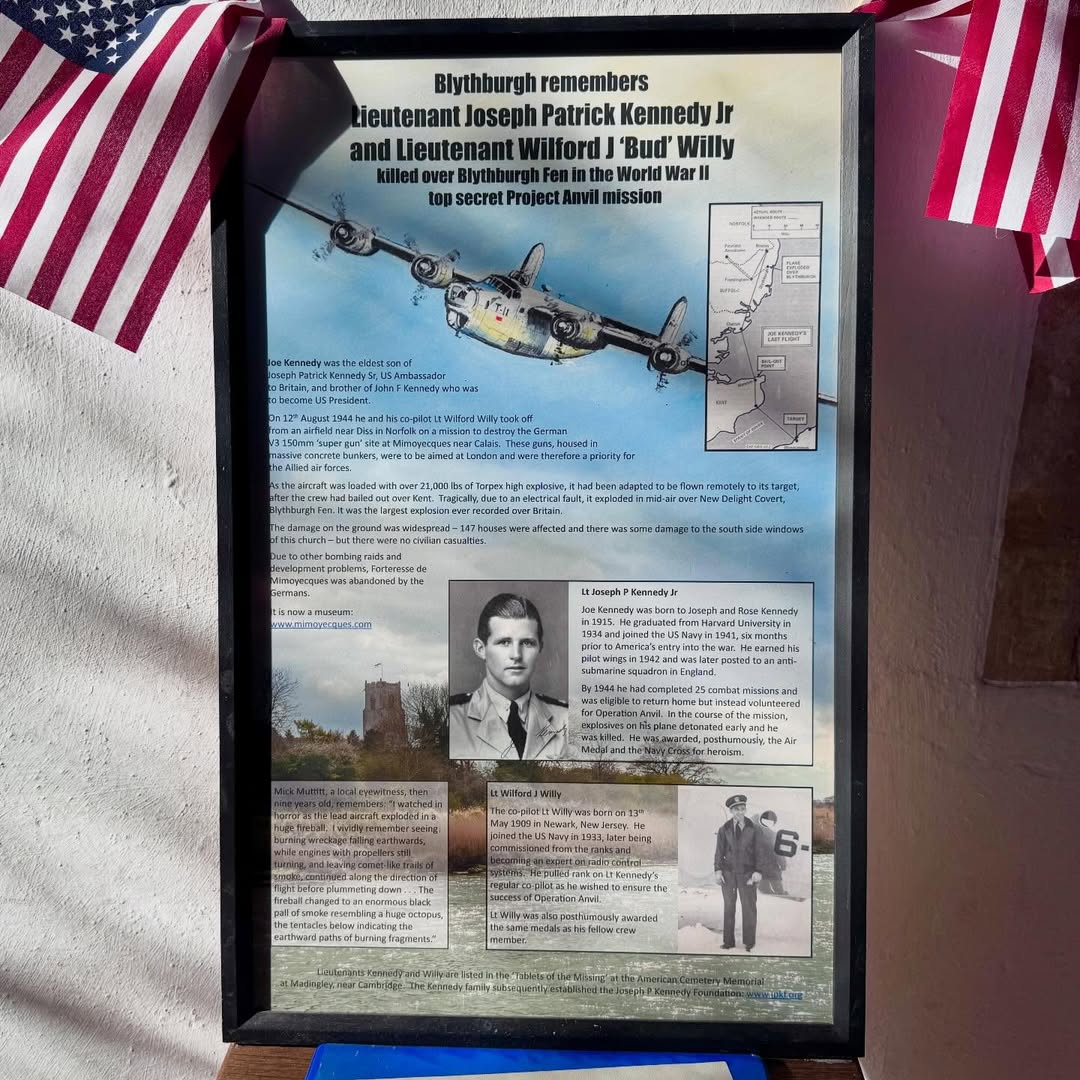
Blythburgh remembers
Lieutenant Joseph Patrick Kennedy Jr and Lieutenant Wilford J 'Bud' Willy
killed over Blythburgh Fen in the World War II
top secret Project Anvil mission
Joe Kennedy was the eldest son of Joseph Patrick Kennedy Sr, US Ambassador to Britain, and brother of John F Kennedy who was to become US President.
On 12tt August 1944 he and his co-pilot Lt Wilford Willy took off from an airfield near Diss in Norfolk on a mission to destroy the German V3 150mm 'super gun' site at Mimoyecques near Calais. These guns, housed in massive concrete bunkers, were to be aimed at London and were therefore a priority for the Allied air forces.
The aircraft was loaded with over 21,000 lbs of Torpex high explosive, it had been adapted to be flown remotely to its target, after the crew had bailed out over Kent. Tragically, due to an electrical fault, it exploded in mid-air over New Delight Covert, Blythburgh Fen. It was the largest explosion ever recorded over Britain.
The damage on the ground was widespread - 147 houses were affected and there was some damage to the south side windows of this church - but there were no civilian casualties. Due to other bombing raids and development problems, Forteresse de Mimoyecques was abandoned by the Germans.
It is now a museum:
www.mimoyecques.com
Lt Joseph P Kennedy Jr
Joe Kennedy was born to Joseph and Rose Kennedy in 1915. He graduated from Harvard University in 1934 and joined the US Navy in 1941, six months prior to America's entry into the war. He earned his pilot wings in 1942 and was later posted to an anti-submarine squadron in England.
By 1944 he had completed 25 combat missions and was eligible to return home but instead volunteered for Operation Anvil. In the course of the mission, explosives on his plane detonated early and he was killed. He was awarded, posthumously, the Air Medal and the Navy Cross for heroism.
Lt Wilford J Willy
The co-pilot Lt Willy was born on 13th May 1909 in Newark, New Jersey. He joined the US Navy in 1933, later being commissioned from the ranks and becoming an expert on radio control systems. He pulled rank on Lt Kennedy's regular co-pilot as he wished to ensure the success of Operation Anvil. Lt Willy was also posthumously awarded the same medals as his fellow crew member.
Mick Muttitt, a local eyewitness, then nine years old, remembers: "I watched in horror as the lead aircraft exploded in a huge fireball. I vividly remember seeing burning wreckage falling earthwards, while engines with propellers still turning, and leaving comet-like trails of smoke, continued along the direction of flight before plummeting down ... The fireball changed to an enormous black pall of smoke resembling a huge octopus, the tentacles below indicating the earthward paths of burning fragments."
Commemorates:
Units:
Naval Aviation
United States Naval Reserve
United States Navy
US Army Air Corps
Wars:
WWII
Battles:
Operation Anvil & Aphrodite
Other images :