






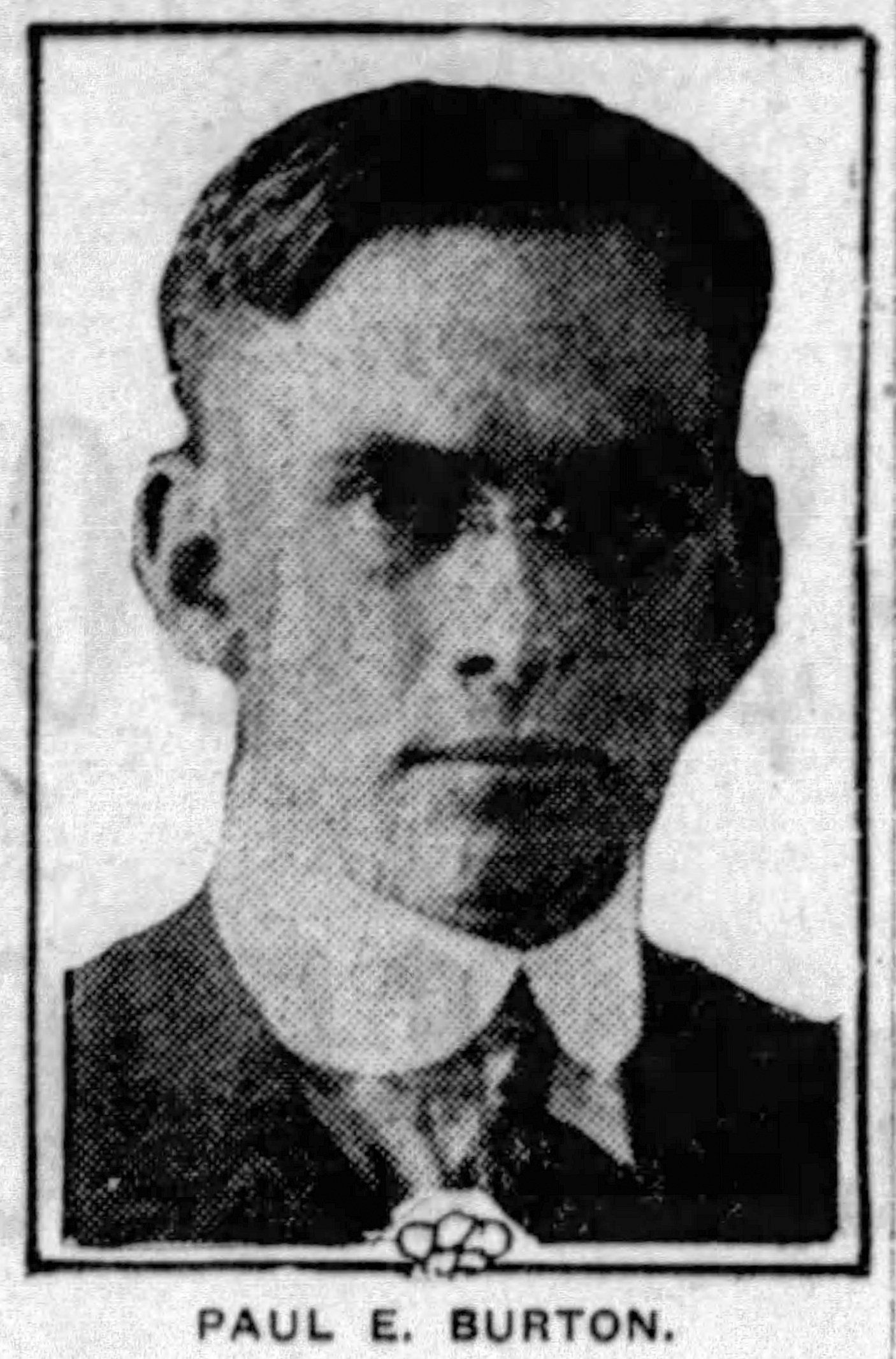
Paul E. Burton is honored on the following 2 monument(s) in our database:
Died in Base Hospital No 25 in Allerey-sur-Saone, France. Originally buried in the town cemetery, under a tall stele erected by the town, as he was the first American to be buried there. After the war, his remains was repatriated to the US for burial, but the stele is still in the town cemetery. Cause of death was drowning. Repatriated by his mother, Mary M. Burton of 143 W College St, Oberlin, OH, to Crete, NE for burial in a family plot.
From Find a A Grave:
Private Paul E Burton served with the Medical Department, Base Hospital #25, in Ohio and at Allerey-sur-Saône commune, France. In enduring ways, his service and death affected not only his family, friends, and other service members, but also the people of the French village where he died.
Paul Edward Burton was born on 26 June 1893 at Kelsey, El Dorado County, California. He was the youngest of three children, all sons, of William and Mary Burton. The family was enumerated at Kelsey in the 1900 US census. William owned a farm free and clear, and worked as a surveyor. Paul, age 6, was attending school. The Burtons retained property at Kelsey through 1910 or later (see Notes). However, in 1910, Paul and Mary were enumerated at Crete, Nebraska, in the household of Mary's mother, Sarah Mathews. Paul, 16, was attending school and not working. An obituary for Mary (Crete Vidette, 19 April 1923) explained that she had moved "back to Crete in 1809 [sic, 1909] to send Paul, her youngest son, to Doane College, and also to care for her father and mother in the old home on Walnut Street." Mary's parents died in 1909 and 1911.
The Burton family suffered another great loss in 1912, when William died unexpectedly during a visit with fellow Union veterans of the Civil War at an old soldiers' colony in Lynn Haven, Florida. "His two sons, William and Paul, went at once and brought his body back to Crete for burial" (Crete Democrat, 3 Apr 1912). Around 1913, Mary and Paul moved to Ohio, probably along with Paul's other brother, Henry. Paul enrolled at Oberlin College, where he graduated in 1916 (Crete Vidette, 15 Aug 1918). Mary Burton made a home at Oberlin with her late husband's sister, Mary B Shurtleff.
Christian faith was important to Paul Burton, who spent a summer as a missionary, "canvassing ... from Nebraska to the coast" (Fremont, Nebraska, Tribune, 3 Sep 1918). Before joining the Army, Paul made sure to have his church letter, a membership document, sent from a congregation in Crete, Nebraska, to the Second Congregational Church at Oberlin, Ohio, which his mother had joined (Crete Vidette Herald, 27 Sep 1917).
The Crete Vidette (15 Aug 1918) described Paul Burton as "a slender, delicately built lad, with the dark eyes that twinkled so like his grandfather Mathews' eyes, when he was amused. With all his quiet modesty Paul made a prominent place for himself at Oberlin especially in the line of literary efforts." His draft card described him as tall, medium weight, with brown hair and brown eyes.
Service and death
When Paul Burton completed draft registration on 5 June 1917, he was living at the YMCA at Dayton, Ohio, and working at National Cash Register Company. He claimed draft exemption: "Enlisted - Base Hospital."
He had, in fact, enlisted on 3 June, just two days before signing his draft card. His serial number was 985220. The Official Roster of Ohio Soldiers, Sailors and Marines in the World War shows that Paul E Burton was assigned to Medical Department, Base Hospital #25. This group trained and served together at Cincinnati, Ohio, in preparation for work at a new hospital center in France. They sailed from New York aboard the USS Lapland on 28 June 1918. The passenger manifest shows Pvt Burton's mother, Mrs Mary M Burton, 143 West College Street, Oberlin, Ohio, as his emergency contact. The Lapland docked at Liverpool, England, on 10 July (Medical Department of the United States Army in the World War, v 2 p 651). The personnel of Hospital #25 arrived at Cherbourg, France, on 12 July.
On 15 July 1918, Pvt Burton and the other staff members of Hospital #25 reached the hospital center at Allerey-sur- Saône. The facilities for Hospital #25 were still under construction and not yet receiving patients. A chaplain later wrote in a condolence letter to Mary Burton, "All of us were soiled with travel and therefore gladly welcomed a bath in the river." After bathing, the men continued to swim and dive (Crete Vidette, 15 Aug 1918). Tragically, although Pvt Burton was an "excellent swimmer," he drowned. "Our doctors worked indefatigably to resuscitate him, but to no avail," wrote the chaplain.
Mourned in two countries
The hospital center was so new that the cemetery was empty. A wooden casket was immediately built for Pvt Burton's remains. His funeral, held the day after he died, included military honors, singing by a quartet of privates, readings, and prayers. The casket was lowered into grave #1, which was marked with a peg and identification tag, standard at the time (Medical Department of the United States Army, p 504).
The funeral drew not only American military personnel but also local people from Allerey-sur-Saône. They shared the Americans' grief, and contributed a floral decoration "made of beads strung on wire ... both attractive and permanent" (chaplain's letter). Pvt Burton's "grave ... was especially honored by the French people of the community, who kept fresh flowers on it all the time" (Omaha Evening World Herald, 19 Feb 1921).
The French continued to honor Pvt Burton long after his death. "A monument to the memory of Private Paul H. [sic] Burton, Base Hospital No. 25, the first soldier buried in the cemetery, was erected by the citizens of Allerey" (Medical Department of the United States Army, p 504), with an inscribed tribute in English:
He ventured
Far to preserve
The liberties
Of mankind.
Pvt Burton's name was recorded in local vital records, inked in the ledger of deaths at Allerey-sur-Saône. After his remains were returned to the United States for reburial, the locals moved his monument from the hospital cemetery to the village graveyard, Cimetière communal d'Allerey-sur-Saône, where it stands as a cenotaph to this day.
At family request, Pvt Burton was returned home for burial near his father and grandparents. His casketed remains were carried aboard the USAT Wheaton, which sailed from Bordeaux to Hoboken, New Jersey, in early 1921. Pvt Burton's burial card shows that his mother accepted the casket at Crete on 19 February 1921.
The following day, the American Legion oversaw Pvt Burton's funeral at the Congregational church at Crete. Friends, family, and veterans attended. Newspapers across America wrote about Pvt Burton's reburial in Nebraska, and lauded the French people of for the care they showed in providing his monument and flowers for his original grave at Allerey-sur-Saône.