




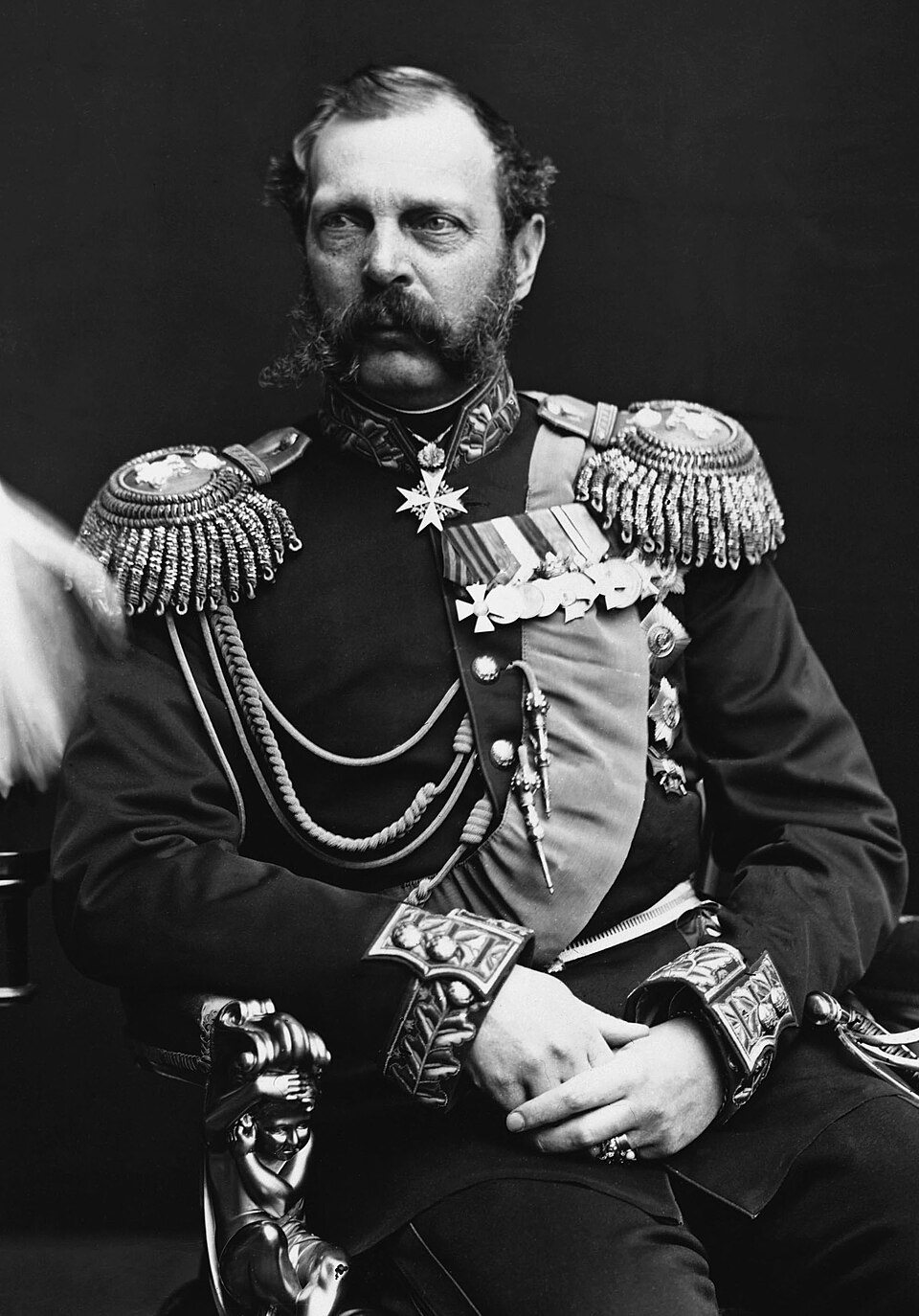
Alexander II was born Alexander Nikolayevich Romanov in Moscow on April 29, 1818, the eldest son of Emperor Nicholas I and Empress Alexandra (born Charlotte of Prussia). Raised in a strict imperial court but educated by the liberal poet Vasily Zhukovsky, he grew up exposed both to autocratic discipline and modern European ideas. As heir, he traveled widely across Russia and Europe, gaining a deeper understanding of his vast empire. In 1841, he married Princess Marie of Hesse, and together they had eight children.
He became emperor in 1855 during the failing Crimean War and quickly ended the conflict, realizing Russia needed major reform. His reign is best known for the Emancipation Edict of 1861, which freed more than 23 million serfs. This landmark reform earned him the title “Tsar-Liberator.” He followed emancipation with sweeping changes: modernizing the army, creating local self-government, expanding railways and industry, reforming the judiciary, easing some censorship, and supporting education.
Yet his rule also showed harshness. He crushed the Polish uprising of 1863, pursued Russification, and approved policies in the Caucasus that resulted in mass displacement of Circassian peoples. Internationally, he favored peace in Europe, supported the Union during the American Civil War, and sold Alaska to the United States in 1867.
Over time, dissatisfaction grew, nobles resisted reforms, peasants felt emancipation was incomplete, and radicals demanded revolution. After surviving several assassination attempts, Alexander shifted toward conservatism, strengthening police control even as he considered limited constitutional reforms.
On March 13, 1881, he was assassinated in St. Petersburg by members of the revolutionary group Narodnaya Volya. His death ended Russia’s most ambitious reform era and was followed by a return to strict autocracy under his son, Alexander III. Despite controversy and contradiction, Alexander II remains one of Russia’s most transformative rulers.
Source of photo and information: Wikipedia

PRIVATE CITIZENS SUPPORTING AMERICA'S HERITAGE
American
War Memorials Overseas, Inc.
War Memorials Overseas, Inc.

Romanov Alexander Nikolayevich
Name:
Alexander Nikolayevich Romanov
Rank:
Commander in Chief
Serial Number:
Unit:
Date of Death:
1881-03-13
State:
Cemetery:
Saints Peter and Paul Cathedral, Saint Petersburg, Russia
Plot:
Row:
Grave:
Decoration:
Comments: