






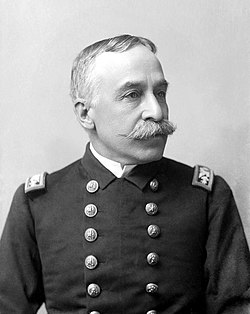
George Dewey is honored on the following 1 monument(s) in our database:
George Dewey was born on December 26, 1837, in Montpelier, Washington County, Vermont. He was the son of Julius Yemans Dewey and Mary Polly Perrin Dewey. He was first married to Susan Boardman Goodwin Dewey and later to Mildred McLean Dewey. He was sent to Norwich University at the age of 15, though he was later expelled for misconduct. He subsequently entered the United States Naval Academy in 1854, graduating in 1858. At the outbreak of the Civil War, he served as executive lieutenant aboard the USS Mississippi and took part in major operations, including the capture of New Orleans and the Siege of Port Hudson, contributing to Union control of the Mississippi River. By the war’s end, he had risen to the rank of lieutenant commander.
In the years following the Civil War, Dewey held a wide range of assignments, serving on several ships, including the USS Constitution, and as an instructor at the Naval Academy. He also worked with the United States Lighthouse Board and the Board of Inspection and Survey. Promoted to commodore in 1896, he was appointed commander of the Asiatic Squadron the following year. Anticipating conflict with Spain, he prepared his forces, and when war began in April 1898, he led the successful assault on Manila Bay, destroying or capturing the entire Spanish Pacific fleet with minimal American casualties. His forces later supported the capture of Manila, and his triumph brought him national acclaim. In 1903, he was promoted to Admiral of the Navy.
Dewey briefly considered seeking the Democratic presidential nomination in 1900 but withdrew and endorsed President William McKinley. He spent his later years serving on the General Board of the United States Navy, a key advisory body, remaining in that role until he died on January 16, 1917. He is now buried in the Washington National Cathedral, Washington, District of Columbia, USA.
Source of photo and information: en.wikipedia.orgGeorge Dewey was born on December 26, 1837, in Montpelier, Washington County, Vermont. He was the son of Julius Yemans Dewey and Mary Polly Perrin Dewey. He was first married to Susan Boardman Goodwin Dewey and later to Mildred McLean Dewey. He was sent to Norwich University at the age of 15, though he was later expelled for misconduct. He subsequently entered the United States Naval Academy in 1854, graduating in 1858. At the outbreak of the Civil War, he served as executive lieutenant aboard the USS Mississippi and took part in major operations, including the capture of New Orleans and the Siege of Port Hudson, contributing to Union control of the Mississippi River. By the war’s end, he had risen to the rank of lieutenant commander.
In the years following the Civil War, Dewey held a wide range of assignments, serving on several ships, including the USS Constitution, and as an instructor at the Naval Academy. He also worked with the United States Lighthouse Board and the Board of Inspection and Survey. Promoted to commodore in 1896, he was appointed commander of the Asiatic Squadron the following year. Anticipating conflict with Spain, he prepared his forces, and when war began in April 1898, he led the successful assault on Manila Bay, destroying or capturing the entire Spanish Pacific fleet with minimal American casualties. His forces later supported the capture of Manila, and his triumph brought him national acclaim. In 1903, he was promoted to Admiral of the Navy.
Dewey briefly considered seeking the Democratic presidential nomination in 1900 but withdrew and endorsed President William McKinley. He spent his later years serving on the General Board of the United States Navy, a key advisory body, remaining in that role until he died on January 16, 1917. He is now buried in the Washington National Cathedral, Washington, District of Columbia, USA.
Source of photo and information: en.wikipedia.org