






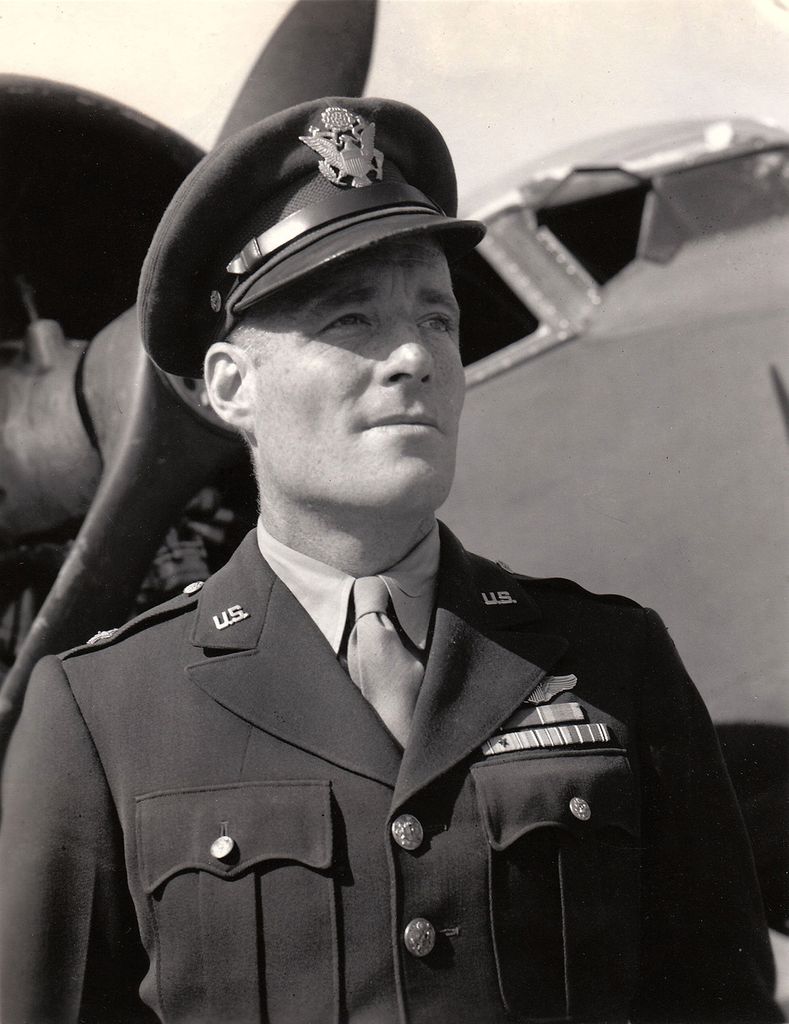
Beirne Jr Lay is honored on the following 1 monument(s) in our database:
Beirne Lay Jr, Army serial number O-309771, was the first combat commander of the 487th Bomb Group (Heavy). He assumed command during the Group's training at Alamogordo Army Airfield, New Mexico on February 28, 1944, and took the Group overseas to England in March 1944. He led the flight echelon, which flew B-24s via the southern Atlantic ferry route and arrived at Army Air Forces Station 137 near Lavenham, Suffolk, England in mid-April 1944.
On May 11, 1944 he flew as Air Leader with the crew of Lt Frank Vratny in B-24H 41-29468 on the 487th Bomb Group's fourth operational mission. This was his second mission leading the Group. The primary target was the railroad marshalling yards at Chaumont, France, southeast of Paris. The secondary target was Troyes. The 487th Bomb Group formation never reached the target. Navigational error resulted in the formation flying over accurate German flak guns guarding the airfield at Chateaudun, France, and Lt Vratny's ship was shot down.Lt Col Lay and Lt Duer bailed out last and landed near each other about nine kilometers northeast of Nogent-le-Rotrou, in the vicinity of Coulonges-les-Sablons, just south of Bretoncelles (vicinity of 48.3865°N, 0.8832°E). Lay and Duer evaded capture with the help of the French, and were hidden with the family of Robert and Georgette Paugoy (Poh-gwah') on Villegager farm, commune of Mazangé, about 15 kilometers northwest of Vendome, France. They were recovered by American troops of the 5th Infantry Division on August 13, 1944. Col Lay wrote about the experience in his book I've Had It, first published in 1945. This book was reissued in 1980 with the title Presumed Dead.
In 1956 he received the Air Force Association's Gill Robb Wilson award for contributions to national defense in the field of arts and letters. He also received the Distinguished Civilian Service Award from the U.S. Air Force. He retired from the Air Force Reserve in 1963 with the rank of Colonel, and was honored by the Mayor of Los Angeles, California, who named October 5, 1963 as "Colonel Beirne Lay, Jr., Day."
Here is an excerpt from the Afterward of The 12 O'Clock High Logbook: The Unofficial History of the Novel, Motion Picture, and TV Series by Allan T. Duffin and Paul Matheis (2005):
In the late 1960s [1967], the 487th Bomb Group, the outfit that Lay had commanded for a short time during World War II, sponsored its first reunion. Lay declined his invitation to attend. He didn't want to discuss the war. "If I had a choice, would I want to relive my wartime experience?" Lay wrote years later. "Definitely not. I couldn't stand the excitement." As he looked over his earlier writings, "the trauma of resurrecting these events … released such a freshet of buried memories, an explosion of downright disbelief, that I had to stop writing. My eyes were blinded by tears."
His last residence was 361 North Bowling Green Way in the Brentwood Heights suburb of Los Angeles, California. He died at UCLA Medical Center in Los Angeles in 1982. He donated his body to the University of California Los Angeles School of Medicine.
The following obituary was written by his friend Brinckerhoff W. Kendall, a classmate at Saint Paul's School (SPS), Concord, New Hampshire in the class of 1927. This was published in Alumni Horae, the school's alumni magazine, in Autumn 1982.
_________________
1927 – Beirne Lay, Jr., a retired Air Force Colonel, died May 26, 1982, in UCLA Medical Center, Los Angeles, after a long illness at home. He was born on September 1, 1909, in Berkeley Springs, West Virginia, the eldest son of Beirne Lay (SPS 1879), a master at the School, and Marion Colston (Hunter) Lay. Entering St. Paul's with the first form of 1920, he sang in the choir all his time at School, joined the Cadmean Literary Society, played on the first Old Hundred football and hockey teams in his sixth form year, and graduated in 1927. Beirne took his B.A. degree at Yale in 1931. At New Haven he boxed and rowed and happened to see a movie, "Wings," starring Buddy Rogers, that fixed the course of his life—it ignited in him a fierce desire to become a pilot.
In June, 1933, at Kelly Field, Texas, he was commissioned a lieutenant in the U.S. Army Air Corps and assigned to the 20th Bombardment Squadron at Langley Field, Virginia, for two years of active duty. More flying than even he could have requested came in the winter of 1934, when the Army was ordered to fly the air mail, with no planning or preparation. He wrote me about his Chicago-Nashville night run: "Airmail pilots fly a day run two or three years as co-pilot before they go out alone, knowing every foot of the ground. They call it legalized murder when we go out at night for the first time alone in ships strange to us and inadequately equipped." In 1937, he dramatically flew a P-6 pursuit plane to Concord for his tenth reunion at St. Paul's, just as his first book I Wanted Wings was being widely displayed in hometown bookstores. In 1938 [Nov 16] Beirne married Miss Ludwell Lee of Hampton, Virginia, in a military ceremony. Two months after Pearl Harbor, in February 1942, he flew to England with Maj. Gen. Ira C. Eaker, who had assembled a staff to organize the Eighth Air Force. As a lieutenant colonel, he became commander of the 487th Bombardment Group. He was shot down over France in April, 1944 [on May 11, 1944], leading his eleventh mission [sic], was concealed by the French Underground, and with their help returned to England after three suspenseful months. His decorations include the Purple Heart, the Distinguished Flying Cross and the Air Medal.
In 1946, Beirne retired with the rank of colonel and returned with his family to Hollywood, to resume writing. He was always tuned to the romance and drama that aviation held for earthmen, and he conveyed the excitement of it all very effectively in such articles as "Should I Jump?", "Death Over the Cities," "I Saw Regensburg Destroyed," "Presumed Dead," and "Down in Flames, Out by Underground." These articles appeared in Saturday Evening Post, Harper's, Fortune, Reader's Digest and Esquire. Besides I Wanted Wings, his best-known books were I've Had It, 12 O'Clock High (with Sy Bartlett), Someone has to Make It Happen, Russia is Winning, and Earthbound Astronauts. Beirne always credited Prof. John Berdan of Yale for his insistent "Identify by specific detail!" He won renown for screenplays for some of the above books plus The Gallant Hours, Jet Pilot, Toward the Unknown, Strategic Air Command, and Above and Beyond—the last two of which won Academy Award nominations. Among his many awards were two he cherished: The Air Force Association arts and letters award of 1956 and a distinguished patriotic service citation from the Department of the Air Force.
Aside from such public success, his personal expressiveness needs recalling. For example, he wrote me once that he had come across the perfect epitaph, inspired by the asterisk in the sports pages opposite the golfer who shoots an 82 in the Masters – "Withdrew." On another occasion, he wrote: "I could never say, as so many people do about their lives, that 'I wouldn't change a minute of it.' I wouldn't live it all over because I couldn't stand the excitement." He had to undergo a fluoroscopy of a lung shadow because "they want to find out if it is malignant, malicious or even vindictive." And later, "Now I'm taking five weeks of laser radiation, five times a week. If this doesn't work, the cry will be, 'Back it up! I'm ready.'" My favorite: When Roger Drury asked him to review Horace Brock's ('26) book, "Flying the Oceans," for the Alumni Horae, Beirne responded "Dear Roger. Roger. Beirne."
Source: Find a Grave