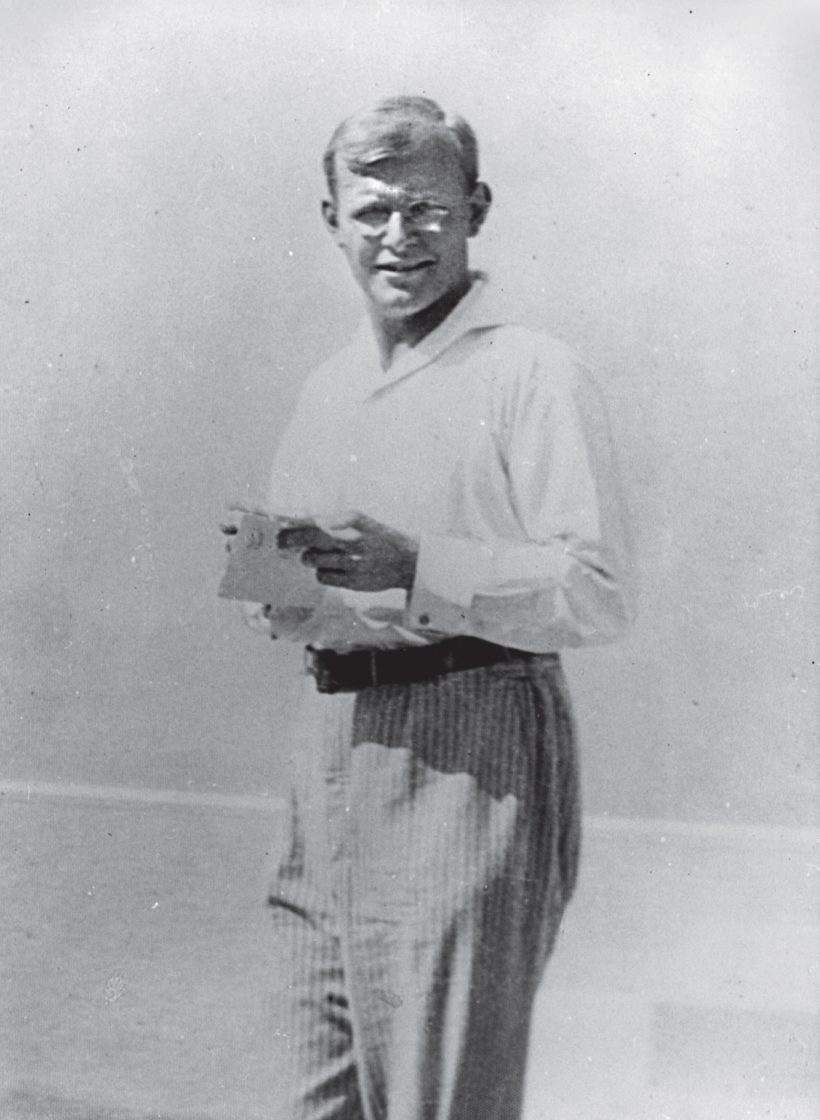






Dietrich Bonhoeffer Plaque
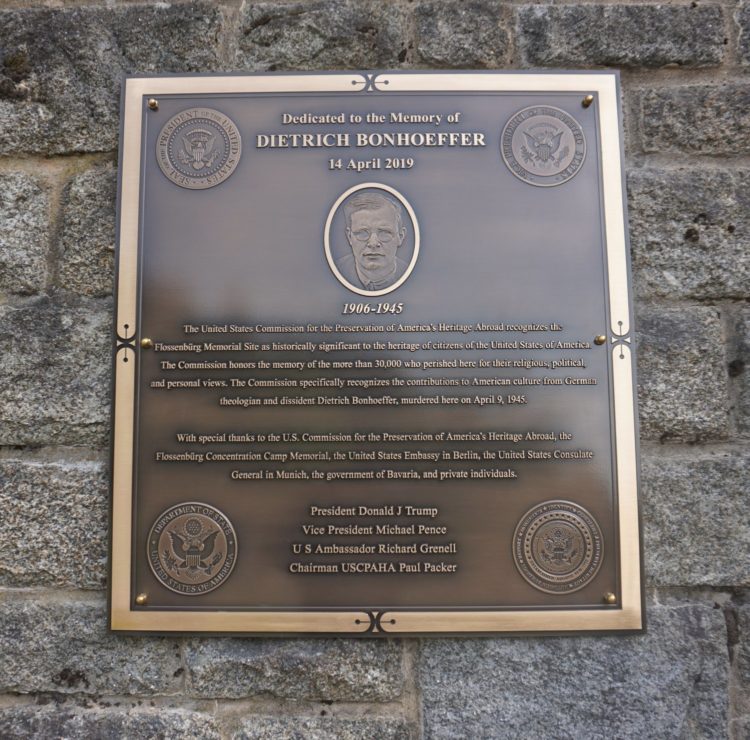
Details:
In the so-called "Valley of the Death" (Tal des Todes) in the concentration camp memorial site
PlaqueA brass inscribed plaque.
The plaque was placed by the United States Governement remembering Dietrich Bonhoeffer. Dietrich Bonhoeffer was a German pastor and theologian known for his opposition to National Socialism. His ties to the July 20, 1944, conspiracy to overthrow the Nazi regime led to his execution in 1945. His theological writings are regarded as classics throughout the Christian world.
From the Flossenburg Memorial website:
Dietrich Bonhoeffer
February 4, 1906 April 9, 1945
Dietrich Bonhoeffer was born in Breslau, the sixth of eight children of the prominent psychiatrist Karl Bonhoeffer and his wife Paula. After completing high school, Dietrich Bonhoeffer began to study Protestant theology and received his doctorate in 1927. He completed his graduate training for the ministry in Barcelona. Next he obtained his qualifi cations to become a professor and completed an academic year in New York. Until 1933, Dietrich Bonhoeffer worked as a lecturer and university pastor in Berlin. He worked with disadvantaged youth in the working-class district of Wedding. A convinced opponent of the National Socialist regime, Dietrich Bonhoeffer spoke in a radio address on February 1, 1933, shortly after the seizure of power, asserting that leaders and governments that worship themselves make a mockery of God. The radio transmission was interrupted because of its unmistakable criticism of the National Socialist principle of leadership. That same year, Dietrich Bonhoeffer accepted a foreign appointment as a pastor in London. He returned to Germany in 1935, and took over the training of young pastors for the Confessing Church. He became one of the leading theologians of this religious opposition movement.
After the regime shut down Dietrich Bonhoeffers seminar, the pastor continued to work underground until 1940. He maintained contact with the military resistance through his brother-in-law, Hans von Dohnanyi. Bonhoeffer accepted an appointment to the Wehrmacht intelligence service, officially in order to defend against espionage with help from his contacts abroad. But unofficially Dietrich Bonhoeffer exploited his position to obtain political support from the Allies for the resistance against Hitler. On April 5, 1943, Dietrich Bonhoeffer was arrested by the Gestapo. He was jailed in Berlin for two years without trial. During this period, he wrote his most important theological works.
In early February 1945, Dietrich Bonhoeffer was transferred to the Buchenwald concentration camp. On April 5, 1945, Adolf Hitler ordered the execution of the remaining conspirators of July 20, 1944. In early April, Dietrich Bonhoeffer was transferred from Buchenwald to Flossenbürg, which at that point was still located a great distance from the approaching front. In addition to Bonhoeffer, six more men from the military resistance were incarcerated in the detention building in the Flossenbürg concentration camp. A summary court trial, headed by Otto Thorbeck and Walter Huppenkothen of the Reich Security Main Office and the camp Kommandant Max Koegel, convicted the seven men of high treason and sentenced them to death. Dietrich Bonhoeffer was hanged by the SS on the morning of April 9 in the courtyard of the detention building. His family did not find out about his death until four months later.
The death sentence against Dietrich Bonhoeffer and the other resistance fighters remained legally valid until the 1990s, and Bonhoeffer was not officially recognized as a victim of National Socialist persecution. In 1996, the National Socialist verdicts were finally overturned, thus formally rehabilitating Dietrich Bonhoeffer. However, since the 1960s, Dietrich Bonhoeffer has been an important symbol of Christian resistance to National Socialism, both within the Protestant Church and beyond. Many church congregations, schools and streets are named after him.
Source: https://www.gedenkstaette-flossenbuerg.de/en/
Monument Text:
Dedicated to the Memory of
DIETRICH BONHOEFFER
14 April 2019
(Picture of Bonhoeffer)
1906-1945
The United States Commission for thePreservation for American Heritage abroad recognizes the
Flossenbürg Memonal Site as historially significant to the heritage of citizens of the United States of America. The Commission honors the memory of the more thas 30,000 who perished here for their, religious, politics, and personal views. The Commission specifically recognizes the contribution to American culture from the German theologian and dissident Dietrich Bonhoeffer, murdered here on April 9, 1945.
With special thanks to the U.S. Commission for the Preservation of America's Heritage Abroad, the Flossenbürg Concentration Camp Memorial, the United States Embassy in Berlin, the United States Consulate General in Munich, the government of Bavaria, and private individuals.
President Donald J Trump
Vice President Michael Pence
US Ambassador Richard Grenell
Chairman USCPAHA Paul Packer