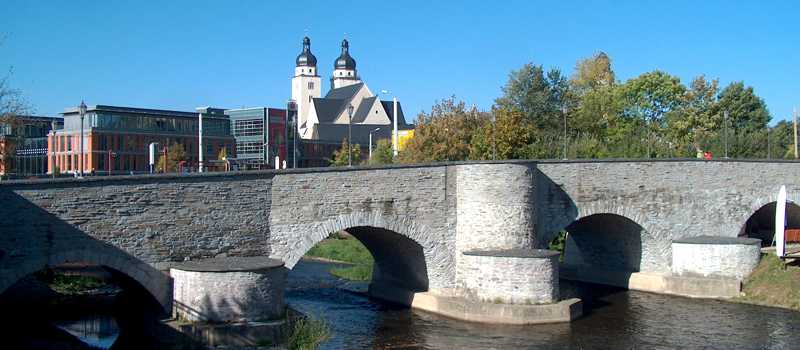






Liberation of Plauen Memorial Plaque -87th Infantry Division
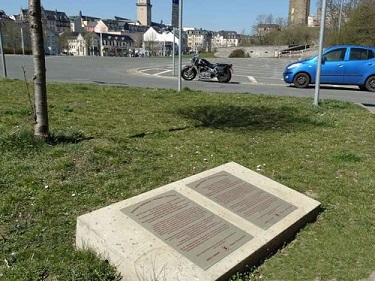
Details:
On the north side of the road.
PlaqueTwo plaques installed near the north end of the Old Elster Bridge (Alte Elsterbrücke) commemorate the liberation of Plauen by elements of the 347th Infantry Regiment, 87th Infantry 'Golden Acorn' Division, U.S. VIII Corps, 3rd U.S. Army at the end of World War II. This event marked the end of the War, and its catastrophic destruction in Plauen, and the historic stone bridge itself spanning the Weisse Elster River remains as a symbol for peace and intercultural understanding among all peoples of the world.
On April 16, 1945, after having been in the forefront of many battles fought by General George S. Pattons Third Army in France, Belgium, Luxembourg, and central Germany, the 347th Infantry Regiment commander Colonel Tupper ordered his 3rd Battalion under LTC Richard Sutton to capture Plauen, Germany. Since Plauen had suffered a total of 14 bombing raids by Allied bombers, of which the last one on 14 April practically leveled the city, the situation was unclear. After a long march through the bombed-out city, the 3rd Battalion arrived in the afternoon at Neustadtplatz near the city center.
Platoon Sergeant Thomas Stafford, the Platoon Leader of 2nd Platoon, Company L of the 347th Infantry Regiment, wrote in his records: Most of the buildings we observed as we moved deeper into Plauen had been severely damaged, many with only a few walls remaining; others were totally destroyed. The majority of the citys streets, many with gaping bomb craters, were nearly impassable... Instead of German soldiers, many Russian, Polish, French, and others -- detainees and prisoners forced to work in local war industries -- filled the streets shouting words of welcome to their liberators.
While the 1st Platoon led the assault down from the north on Pausaer Strasse, Captain Richard Kidd, Commander of Company L, received a message from an observation plane that the Germans were making efforts to blow up the bridge over the Elster River. Kidd ordered Sergeant Staffords 2nd Platoon to advance and secure the bridge, reinforced by several tanks from an armored unit.
Stafford recalled that when we arrived at the bridge, we saw a group of Germans who obviously were occupied with preparations to blow up the bridge. I stationed one tank each on either side of our end of the bridge, and under the salvos from the tanks, my men and I marched across the bridge, hoping to defuse the demolition charges.
They succeeded. The Platoon secured the area beyond the bridge without any problems and captured some of the German soldiers who attempted to flee.
In his rush to save the bridge, Stafford had failed to secure his perimeter by searching the surrounding buildings, which could have been a fatal error. A Company K platoon arriving later under the command of 2nd Lieutenant Ray Stender found a group of German soldiers in a basement who obviously had orders to destroy the bridge. Fortunately, they did not intervene.
On April 16, 2010, a private initiative known as the Liberty Convoy commemorated the march of the U.S. Army 87th Infantry Division into Plauen in 1945, retracing the invasion route over three days with the participation of five U.S. veterans who had reached the Vogtland region during World War II.
In 2015, Liberty Convoy, in cooperation with U.S. officials as well as the City of Plauen, Bürgerstiftung Plauen (Civic Foundation Plauen), and the Förderverein Komturhof Plauen e.V. (Foundation Komturhof Plauen), emplaced the commemorative plaques on stone foundations near the Old Elster Bridge.
Source of information: wege-der-befreiung.org/en, www.plauen-erinnern.de/bridges-connect-en.html, www.normandy1944.info/stories/thomas-stafford, 87thinfantry.org, www.sandstein-kultur.de
Monument Text:
Left Plaque text:
Brücken verbinden -- Bridges connect
Am 16. April 1945 erreicht die 87. Infanterie-Division des 3. US-
Armee die Stadt. Am diesen tag beendete für Plauen den
Zweiten Weltkrieg und seine katastrophale Zerstörung. Die
historische Steinbrücke über die Weiße Elster soll als Symbol für
den Frieden und Völksverständigung gelten.
Im Zweiten Weltkrieg, der mit dem deutschen Überfall auf Polen
am 7. September 1939 begann und im weiteren Verlauf auf
zahlreiche Länder ausgebreitet, entwickelte sich Plauen zu
einem wichtigen industriellen und logistischen Zentrum der
Kriegsanstrengungen. Vor allem aufgrund ihrer
rüstungswirtschaftlich Bedeutung und wegen der zentralen
Verkehrslage wurde die Stadt in den Jahren 1944-45 insgesamt
14 mal von britischen und amerikanischen Flugzeugen
bombardiert. Mindestens 2.258 Menschen erlitten dabei den
Tod. In Plauen wurden 364 Wohn- und Industriellen Gebäude
zerstört or beschädigt.
Der Zweite Weltkrieg endete für die Plauener am 16. April 1945,
als Einheiten der 87. Infanterie-Division, VIII. Korps, 3. US-
Armee die Stadt besetzten. Nach Augenzeugenberichten
verhinderten an diesem Tag Sergeant Thomas L. Stafford,
Zugführer der L-Kompanie des 347. Infanterie-Regiments der
US-Armee und seine Soldaten die Sprengung der historischen
Steinbrücke.
Die 87. Infanteriedivision wurde am 29. Mai 1945 von der 36.
Infanteriedivision abgelöst, die wiederum am 3. Juli 1945 Plauen
und das Vogtland gemäß den alliierten Vereinbahrungen am
diesen Platz an die Rote Armee uberführt.
Dieses Gedenktafel entstand auf Initiative der Organisatoren des
Liberty Convoy 2010.
LIBERTY CONVOY [87ID patch] Plauen, 16. April 2015
Right Plaque text:
Bridges connect - Brücken verbinden
On April 16, 1945, the 87th Infantry Division of the 3rd U.S. Army
entered the city, ending for Plauen the Second World War and its
catastrophic destruction. Today the historic stone bridge
spanning the Weisse Elster river remains as a symbol for peace
among all peoples of the world.
During the Second World War, which began with the German
invasion of Poland on September 7, 1939 and its further
expansion to numerous countries, Plauen developed into a
major industrial and logistical hub for the war effort. For that
reason the city was the destination of 14 air raids during 1944
and the first 4 months of 1945 by British and U.S. American
bomber fleets, resulting in more than 2,358 civilian casualties as
well as the destruction or damage of 364 of the residential and
industrial buildings in the city.
World War II ended for the inhabitants of Plauen on April 16,
1945, when troops of the 87th Infantry Division, VIII Corps, 3rd
U.S. Army rolled into the town. According to eye witnesses on
this day Sergeant Thomas L. Stafford, platoon leader of L
Company of the 347th Infantry Regiment of the U.S. Army, and
his soldiers prevented the dynamiting of the historical stone bridge.
The 87th Infantry Division was relieved on May 29, 1945 by the
36th Infantry Division which in turn relinquished Plauen and the
Vogtland region on July 3, 1945, to the Red Army in this historic
location, in accordance with the Allied Agreements.
This memorial was commissioned by the organizers of the Liberty Convoy 2010.
LIBERTY CONVOY [87ID patch] Plauen on April 16, 2015
Commemorates:
People:
Units:
347th Infantry Regiment, 87th Infantry Divsion
3rd US Army
87th Infantry Division
United States Army
VIII Corps
Wars:
WWII
Other images :