





B-17 (41-24620) 'Snap! Crackle! Pop!' Crash Information Board
Details:
Next to the marker.
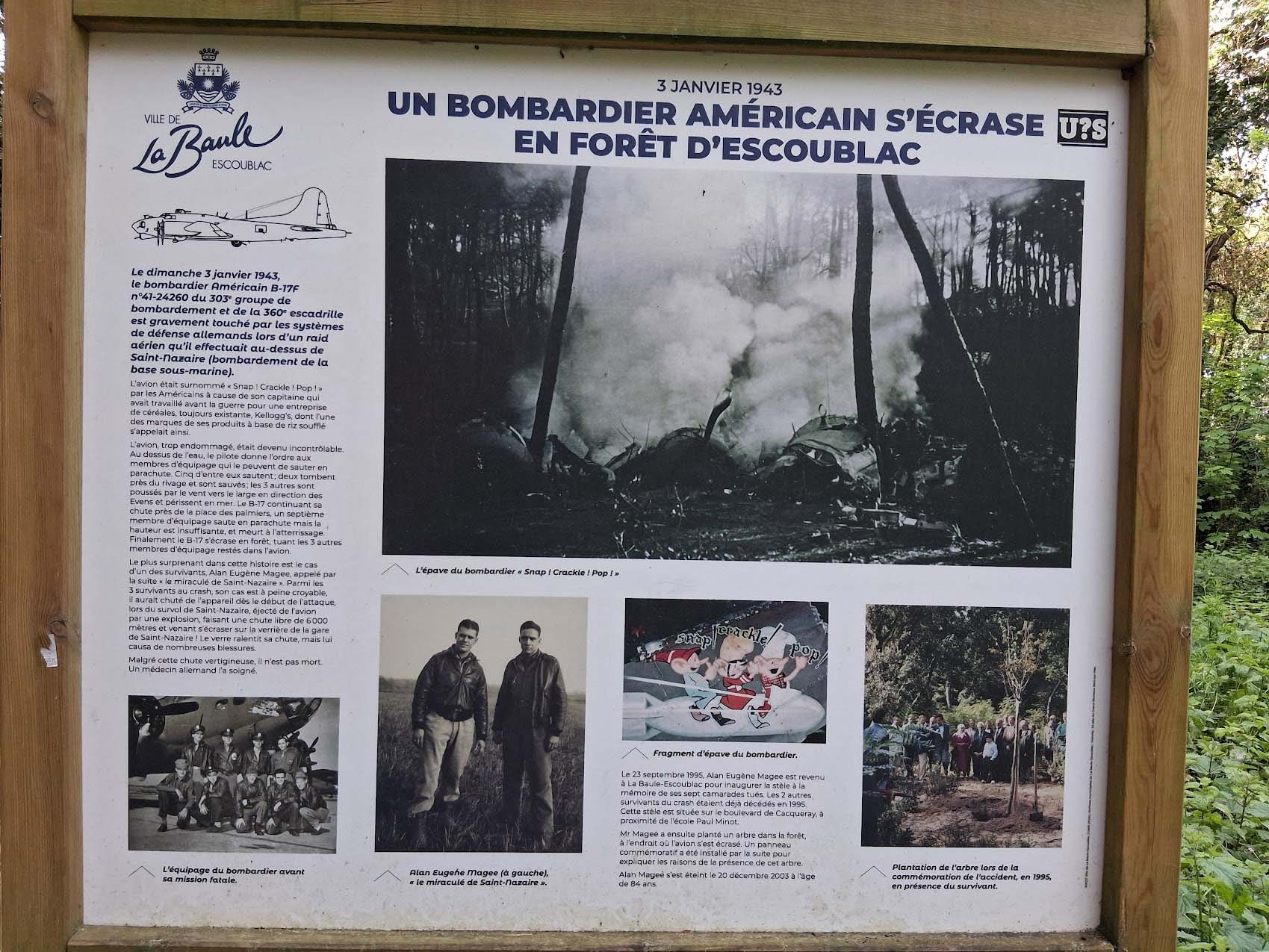
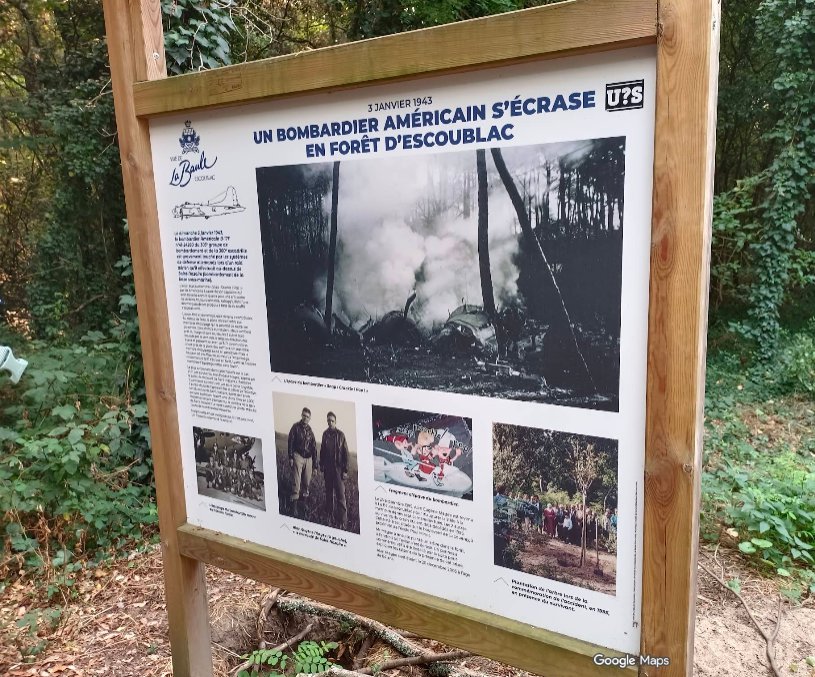
MarkerA rectangular information board mounted in a wooden frame presents the story of the crash of B-17 #41-24260, with text written in French. The panel features images of the crew and a photograph of the aircraft wreckage in the forest, along with additional historical photos and illustrations. It outlines details about the bomber, its mission over Saint-Nazaire, and the damage it sustained before crashing in the Escoublac forest. The board also describes the fate of the crew members and highlights the remarkable story of survivor Alan Eugene Magee.
Monument Text:
3 JANVIER 1943
UN BOMBARDIER AMÉRICAIN SÉCRASE
EN FORÊT DESCOUBLAC
JANUARY 3, 1943
AN AMERICAN BOMBER CRASHES
IN THE ESCOUBLAC FOREST
First Column text:
Le dimanche 3 janvier 1943, le bombardier Américain B-17F n°41-24260 du 303e groupe de bombardement et de la 360e escadrille est gravement touché par les systems de défense allemands lors dun raid aérien quil effectuait au-dessus de Saint-Nazaire (bombardement de la base sous-marine).
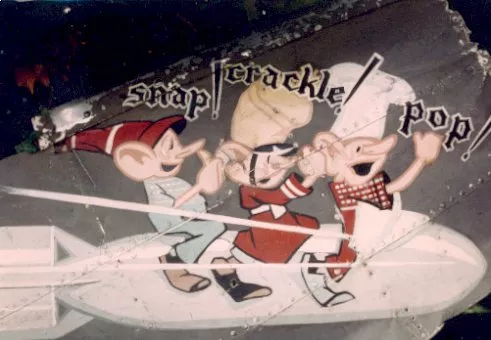
Lavion était surnommé « Snap ! Crackle ! Pop ! » par les Américains à cause de son capitaine qui avait travaillé avant la guerre pour une entreprise de céréales, toujours existante, Kelloggs, dont lune des marques de ses produits à base de riz soufflé sappelait ainsi.
Lavion, trop endommagé, était devenu incontrôlable.
Au dessus de leau, le pilote donne lordre aux membres déquipage qui le peuvent de sauter en parachute. Cinq dentre eux sautent; deux tombent près du rivage et sont sauvés; les 3 autres sont poussés par le vent vers le large en direction des Evens et périssent en mer. Le B-17 continuant sa chute près de la place des palmiers, un septième membre déquipage saute en parachute mais la hauteur est insuffisante, et meurt à latterrissage. Finalement le B-17 sécrase en forêt, tuant les 3 autres membres déquipage restés dans lavion.
Le plus surprenant dans cette histoire est le cas dun des survivants, Alan Eugène Magee, appelé par la suite « le miraculé de Saint-Nazaire ». Parmi les 3 survivants au crash, son cas est à peine croyable, il aurait chuté de lappareil dès le début de lattaque, lors du survol de Saint-Nazaire, éjecté de lavion par une explosion, faisant une chute libre de 6000 mètres et venant sécraser sur la verrière de la gare de Saint-Nazaire ! Le verre ralentit sa chute, mais lui causa de nombreuses blessures.
Malgré cette chute vertigineuse, il nest pas mort. Un médecin allemand la soigné.
English translation:
On Sunday, January 3, 1943, American B-17F bomber No. 41-24260 of the 303rd Bombardment Group and 360th Squadron was severely damaged by German air defenses during a raid over Saint-Nazaire (bombing the submarine base).
The aircraft was nicknamed "Snap! Crackle! Pop!" by the Americans because its captain had worked before the war for Kellogg's, a cereal company that still exists today, and one of its puffed rice products bore the same name.
The aircraft was too badly damaged to be controlled. Over the water, the pilot ordered the crew members who were able to bail out. Five of them jumped; two landed near the shore and were rescued; The other three were blown by the wind out to sea towards the Evens Islands and perished at sea. As the B-17 continued its descent near the Place des Palmiers, a seventh crew member parachuted to safety, but the altitude was insufficient, and he died upon landing. Finally, the B-17 crashed in the forest, killing the three remaining crew members.
The most surprising aspect of this story is the case of one of the survivors, Alan Eugène Magee, later known as "the miracle of Saint-Nazaire." Of the three survivors of the crash, his case is almost unbelievable. He reportedly fell from the aircraft at the very beginning of the attack, while flying over Saint-Nazaire, was ejected by an explosion, falling 6,000 meters, and crashed into the glass roof of the Saint-Nazaire train station! The glass slowed his fall but caused him numerous injuries.
Despite this vertiginous fall, he did not die. A German doctor treated him.
Third Column text:
Fragment dépave du bombardier.
Le 23 septembre 1995, Alan Eugène Magee est revenu à La Baule-Escoublac pour inaugurer la stèle à la mémoire de ses sept camarades tués. Les 2 autres survivants du crash étaient déjà décédés en 1995. Cette stèle est située sur le boulevard de Cacqueray, à proximité de lécole Paul Minot.
Mr Magee a ensuite planté un arbre dans la forêt, à lendroit où lavion sest écrasé. Un panneau commémoratif a été installé par la suite pour expliquer les raisons de la présence de cet arbre.
Alan Magee sest éteint le 20 décembre 2003 à lâge de 84 ans.
English translation:
Fragment of the bomber wreckage.
On September 23, 1995, Alan Eugène Magee returned to La Baule-Escoublac to unveil the memorial stone dedicated to his seven comrades who were killed. The two other survivors of the crash had already passed away by 1995. This memorial stone is located on Boulevard de Cacqueray, near the Paul Minot school.
Mr. Magee then planted a tree in the forest at the site of the plane crash. A commemorative plaque was later installed to explain the reason for the tree's presence.
Alan Magee passed away on December 20, 2003, at the age of 84.
Commemorates:
People:
Michael Lawrence “Mike”, Jr. Libonati
Units:
303rd Bomber Group
360th Bomber Squadron, 303rd Bomb Group, Heavy
8th Air Force
United States Air Force
Wars:
WWII
Other images :