





Battle of Ormoc Bay Navel Ship War Graves Memorial
Details:
Located approximately 230 meters east of the Battle of Ormoc Bay Historical Marker.
PlaqueA series of rectangular commemorative plaques, mounted beneath transparent protective panels on stone pedestals, recognizes the sunken warships and their wreck sites as war graves and an integral part of Ormocs cultural heritage. The plaques honor the sacrifices of those who fought in the Philippines during World War II and highlight the importance of preserving and protecting these underwater historical sites.
Monument Text:
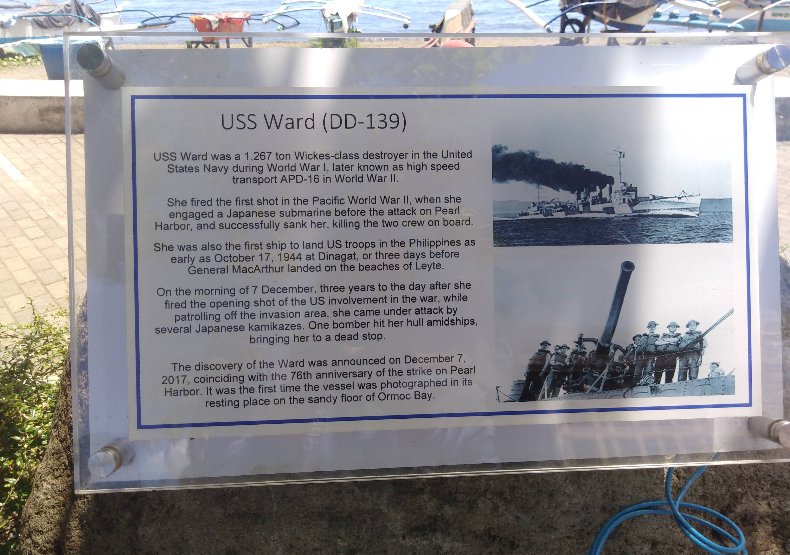
USS Ward (DD-139)
USS Ward was a 1,267 ton Wickes-class destroyer in the United States Navy during World War I, later known as high speed transport APD-16 in World War II.
She fired the first shot in the Pacific World War II, when she engaged a Japanese submarine before the attack on Pearl Harbor, and successfully sank her, killing the two crew on board.
She was also the first ship to land US troops in the Philippines as early as October 17, 1944 at Dinagat, or three days before General MacArthur landed on the beaches of Leyte.
On the morning of 7 December, three years to the day after she fired the opening shot of the US involvement in the war, while patrolling the invasion area, she came under attack by several Japanese kamikazes. One bomber hit her hull amidships, bringing her to a dead stop.
The discovery of the Ward was announced on December 7, 2017, coinciding with the 76th anniversary of the strike on Pearl Harbor. It was the first time the vessel was photographed in its resting place on the sandy floor of Ormoc Bay.
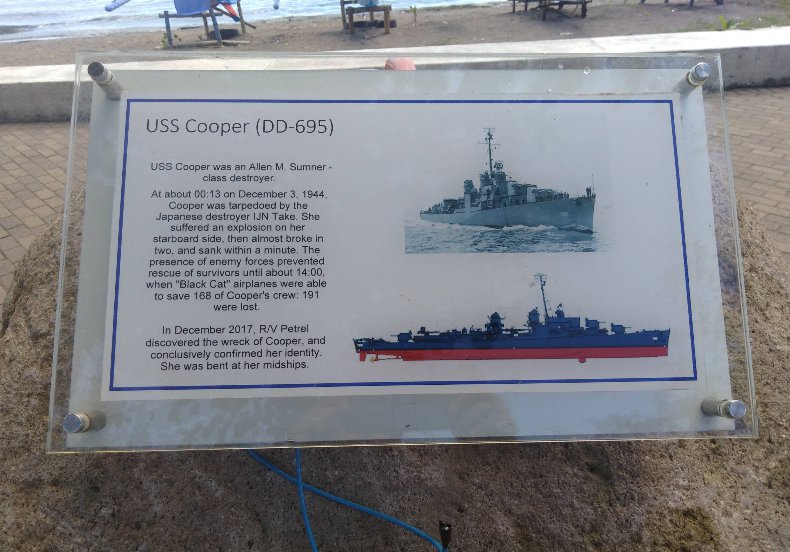
USS Cooper (DD-695)
USS Cooper was an Allen M. Sumner-class destroyer.
At about 00:13 on December 3, 1944, Cooper was torpedoed by the Japanese destroyer IJN Take. She suffered an explosion on her starboard side, then almost broke in two, and sank within a minute. The presence of enemy forces prevented rescue of survivors until about 14:00, when "Black Cat" airplanes were able to save 168 of Cooper's crew: 191 were lost.
In December 2017, R/V Petrel discovered the wreck of Cooper, and conclusively confirmed her identity. She was bent at her midships.
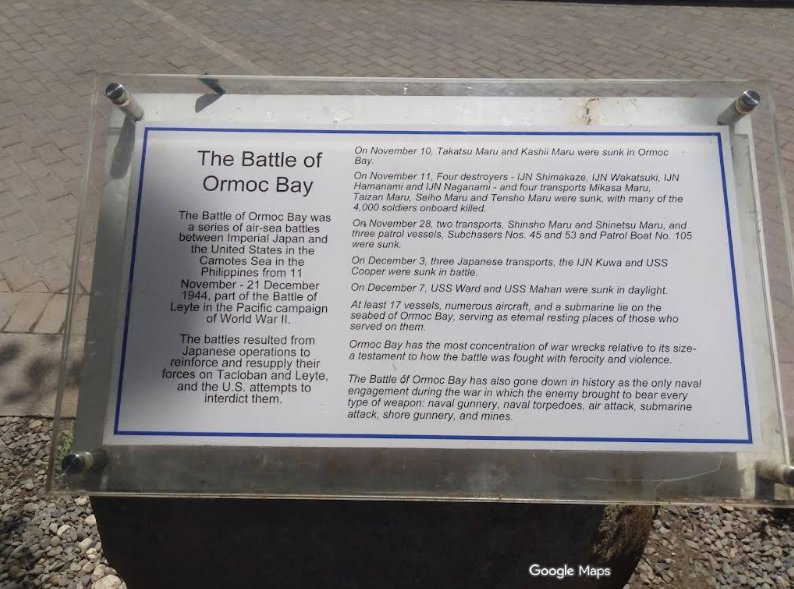
The Battle of Ormoc Bay
The Battle of Ormoc Bay was a series of air-sea battles between Imperial Japan and the United States in the Camotes Sea in the Philippines from 11 November - 21 December 1944, part of the Battle of Leyte in the Pacific campaign of World War II.
The battles resulted from Japanese operations to reinforce and resupply their forces on Tacloban and Leyte, and the U.S. attempts to interdict them.
On November 10, Takatsu Maru and Kashii Maru were sunk in Ormoc Bay.
On November 11, Four destroyers - IJN Shimakaze, IJN Wakatsuki, IJN Hamanami and IJN Naganami - and four transports Mikasa Maru, Taizan Maru, Seiho Maru and Tensho Maru were sunk, with many of the 4,000 soldiers onboard killed.
On November 28, two transports, Shinsho Maru and Shinetsu Maru, and three patrol vessels, Subchasers Nos. 45 and 53 and Patrol Boat No. 105 were sunk.
On December 3, three Japanese transports, the IJN Kuwa and USS Cooper were sunk in battle.
On December 7, USS Ward and USS Mahan were sunk in daylight.
At least 17 vessels, numerous aircraft, and a submarine lie on the seabed of Ormoc Bay, serving as eternal resting places of those who served on them.
Ormoc Bay has the most concentration of war wrecks relative to its size - a testament to how the battle was fought with ferocity and violence.
The Battle of Ormoc Bay has also gone down in history as the only naval engagement during the war in which the enemy brought to bear every type of weapon: naval gunnery, naval torpedoes, air attack, submarine attack, shore gunnery, and mines.