





Home Run Monument (WWII Escape Lines)
<< Back to Royal British Legion National Remembrance Gardens (Orange Zone)
Details:
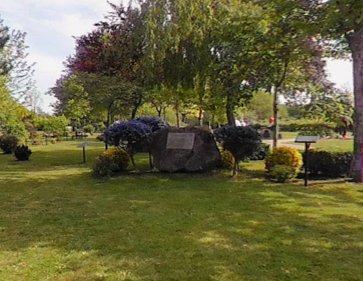
Located within the Allied Special Forces Memorial Grove, northeast of the Combined Operations Memorial.
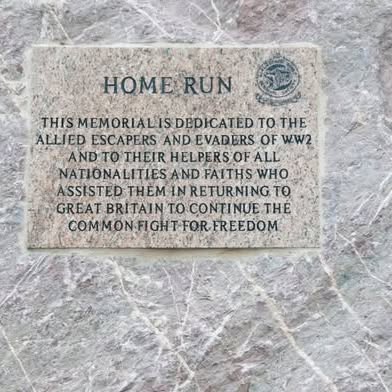
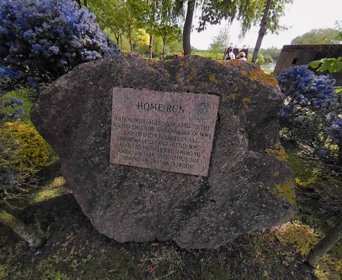
MonumentA memorial stone Home Run and an information marker commemorate the Allied escapers and evaders of World War 2 and those who helped them. The WW2 Escape Lines Memorial Society created the monument from a rock from a quarry in the Pyrenees mountains belonging to the family of an evasion helper who acted as a guide over those same mountains. The monument stone, dedicated in 2012, includes an inscription in English and the symbol of the WW2 Escape Lines Memorial Society. The information marker alongside the stone comprises an engraved metal plaque on a stand.
Escape and evasion lines in World War II helped people escape European countries occupied by Nazi Germany. The focus of most escape lines in Western Europe was assisting American, British, Canadian and other Allied airmen shot down over occupied Europe to evade capture and escape to Gibraltar, neutral Spain or Sweden, from where they could return to the United Kingdom. British Military Intelligence Section 9 (MI9), British Special Operations Executive (SOE), and other Allied organizations coordinated most operations and support for the effort to recover escapers (soldiers and airmen who had been captured by the Germans and escaped) and evaders (soldiers and airmen in enemy territory who evaded capture). Most of those helped by escape lines were evaders. MI9 focused on escape and evasion support, while SOE -- alongside the American Office of Strategic Services (OSS) and other organizations -- focused on espionage, sabotage, and guerrilla warfare behind enemy lines, but functions often overlapped in running escape and evasion lines.
Some escape and evasion lines such as the Shelburne or Burgundy Lines were created by the Allies specifically to assist their soldiers and airmen stranded in German-occupied territory. Others were the product of a combination of Allied military personnel and local citizens in occupied territory, such as the Pat OLeary Line (also known as the Pat Line). Some escape lines were created and operated by civilians as grassroots efforts to help people fleeing the Nazis, such as Comet, Dutch-Paris, Service EVA, or the Smit-van der Heijden line. They did not restrict themselves to helping military personnel but also helped compromised spies, resisters, men evading the forced labor drafts, civilians who wanted to join the governments-in-exile in London, and Jews.
About 7,000 airmen and soldiers, mostly American, British, and Canadian, were helped to evade German capture in Western Europe and successfully returned through the United Kingdom during World War II.
Oaktree/Shelburne Line: MI9s first attempt, called the Oaktree Line, to set up an escape line for aircrew by boat from Brittany to England failed due to German infiltration and poor leadership in mid-1943. Its successor, the Shelburne Escape Line, helped more than 300 airmen (including about 94 U.S. aircrew members), SOS teams, French resistance agents, and other civilians evade German capture in the short time it was active from January to August 1944. In addition to those aircrew evacuated to England, the associated Francois Line in Paris helped aircrew escape to neutral Spain or shelter in place in a forest refuge in France.
Russian-born American MI9 agent Vladimir Buryshkin (also known as Val Williams or Guillaume) assisted the evasion of about 100 Allied personnel along the Oaktree Line.
One helper of note along the Oaktree Line was the American Roberta Betty (Laurie) Countess de Mauduit, who chose to stay alone with household staff at Chateau du Bourblanc in Plourivo on the north coast of Brittany when her French husband Henri left to join Free French Forces in 1939. Certain that her U.S. citizenship and social status would give her sufficient protection, she assumed risk, initially providing support to resistance efforts, then started cooperation with MI9 in April 1943. Before her capture only a few months later, she sheltered about 39 Allied aircrew members transiting along Oaktree Line, including from U.S. B-17 aircraft #42-5717, #42-5232 (Available Jones), #42-5378, #42-29627 (Midnight), and #42-29767 (Boot Hill). Five members of the latter crew managed to avoid capture when the Gestapo searched the Chateau and arrested her on 17 June 1943. She was detained, interrogated, and tortured at sites including Ravensbrück and later Buchenwald, from which the U.S. 69th Infantry Division freed her in April 1945.
Pat (or Pat OLeary) Line: Pat OLeary was the pseudonym of Albert Guérisse, one of the early leaders of the line, which helped more than 600 Allied soldiers and airmen escape from France to Spain. More than 100 volunteers or helpers, mostly French, working for the Pat Line were arrested and imprisoned by Vichy French or German authorities. Most were imprisoned for the remainder of the war, but many were executed or died in concentration camps. American OSS/SOE agent Virginia (Goillot) Hall (also known as the limping lady, codename Bookworm and about a dozen other aliases) helped Allied personnel evade along the Pat Line, in addition to directing combat resistance operations.
Comet (or Comète) Line: The Comet Line was the largest of several escape networks in occupied Europe. In three years, the Comet Line helped 776 people, mostly British and American airmen, escape to Spain or evade capture in Belgium and France. An estimated 3,000 civilian helpers, mostly Belgians and French, assisted the Comet Line. Seven hundred helpers were arrested by the Germans, and 290 were executed or died in prison or concentration camps. The Comet Line maintained its operational independence, but received financial assistance from MI9.
MI9 developed Operation MARATHON, associated with the Comet Line, to gather downed airmen into isolated forest camps where they would await their rescue by allied military forces advancing after the Normandy Invasion of 6 June 1944. The most important of the forest camps, code named Sherwood, was in the Fréteval forest of France and sheltered 152 British and American airmen between May and August 1944. MI9 executive Airey Neave and a small Allied force liberated the airmen on 14 August 1944. Other forest camps in France and the Ardennes forest in Belgium held another 150 or more airmen who were liberated with the advance of the Allied armies. One American agent, Virginia Caroline (Roush) dAlbert-Lake (also known as Virginia), was caught leading five airmen from one of the forest camps, was tortured, and then sent to the Ravensbrück camp, from where she came back alive at the end of the War.
Some American Operator and helpers:
- Virginia Caroline (Roush) dAlbert-Lake (also known as Virginia) https://www.uswarmemorials.org/html/people_details.php?PeopleID=31804
- Vladimir Pavlovich Buryshkin (also spelled Bouryshkine, also known as Val Williams or codename Guillaume) https://www.uswarmemorials.org/html/people_details.php?PeopleID=42354
- Roberta Betty (Laurie) Countess de Mauduit https://www.uswarmemorials.org/html/people_details.php?PeopleID=42426
- Virginia (Goillot) Hall, Pat Line, SOE/OSS agent https://www.uswarmemorials.org/html/people_details.php?PeopleID=34521
Sources of information: alliedspecialforcesmemorialgrove.org, ww2escapelines.co.uk, en.wikipedia.org
Monument Text:
HOME RUN
THIS MEMORIAL IS DEDICATED TO THE ALLIED
ESCAPERS AND EVADERS OF WW2
AND TO THEIR HELPERS OF ALL
NATIONALITIES AND FAITHS WHO
ASSISTED THEM IN RETURNING TO
GREAT BRITAIN TO CONTINUE THE
COMMON FIGHT FOR FREEDOM