






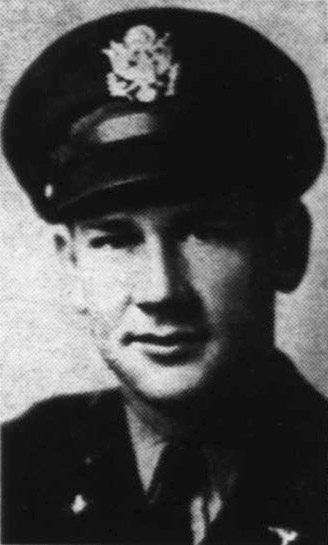
Winston Somers Rogers is honored on the following 1 monument(s) in our database:
Winston Somers Rogers was born at Saint Petersburg, Pinellas County, Florida on June 3, 1919. His parents were Mitchell Calvin Rogers (19 May 1885 – 5 Oct 1966) and Abbie M. (Somers) Rogers (15 Apr 1891 – 8 Dec 1981), who were born in Florida. His parents married at Jacksonville, Duval County, Florida on August 25, 1911. His father owned and operated a dry cleaning business on Central Avenue in Saint Petersburg, Florida. He had a brother, Mitchell Calvin Rogers Jr (called Calvin) (21 Apr 1912 – 18 Nov 1978); and a sister, Doris E. (Rogers) Walker (20 Mar 1915 – 11 Sep 1990). In 1918 the family lived at 1704 Central Avenue, St Petersburg. By 1930 the family home was on Lealman Avenue in Saint Petersburg.
He graduated from Saint Petersburg High School in 1937 and from Louisiana State University in 1941, where he majored in aviation and business. He was employed by Eastern Air Lines in New Orleans, Louisiana, and was manager of their Montgomery, Alabama office for one year before enlisting in the Army Air Corps at Tampa, Florida on July 2, 1942. He was 5 feet 9 inches tall, weighed 160 pounds, and had hazel eyes and brown hair. He trained to be an Army Air Forces pilot at Maxwell Field, Alabama; Union City, Tennessee; and Blytheville, Arkansas. He completed the course at Blytheville, Arkansas, and received his wings and commission as a Second Lieutenant on May 28, 1943. In June 1943 he went on to four-engine heavy bomber transition training in the B-24 'Liberator' bomber at Smyrna Army Air Field, Tennessee, in order to qualify as pilot in command of that aircraft type.
He was assigned a crew and began B-24 crew training at Gowen Army Air Base, Idaho. He continued this training with the 538th Bomb Squadron of the 382nd Bomb Group at Pocatello Army Air Base, Idaho. On November 20, 1943, his crew was reassigned to the 836th Bomb Squadron of the 487th Bomb Group at Bruning Army Air Base, Nebraska. In December 1943 the 487th Bomb Group moved to Alamogordo Army Air Base New Mexico. He was promoted to First Lieutenant effective December 10, 1943, just before the move to Alamogordo.
The Rogers crew completed B-24 crew training with the 487th Bomb Group at Alamogordo, and deployed with the Group to England in March 1944. The crew flew B-24 42-52625 overseas via the southern Atlantic ferry route—a journey of about 10,000 miles—and arrived in England by mid-April 1944. The 487th Bomb Group was based at Army Air Forces Station 137 near Lavenham, Suffolk, England, and was part of the 8th U.S. Army Air Force in Europe.
At Lavenham the Rogers crew became a lead crew. Then Lt Rogers was taken off the crew and became the Operations Officer of the 836th Bomb Squadron, and an Air Leader. In July 1944 the 487th Bomb Group transitioned to flying the B-17 'Flying Fortress'. On August 25, 1944, Lt Rogers flew as Air Leader with the crew of Lt Joseph A. Duncan in the 839th Bomb Squadron, on a mission to bomb the German airfield at Rechlin, Germany.
The Duncan crew took off from Lavenham Airfield in B-17G 43-37980, and flew in the deputy lead position of the Lead Squadron. Copilot Lt James Hood Jr moved to the tail gunner position as Officer Tail Gunner and formation observer, as was the custom. Lt Rogers and eight of his crew mates were killed in action when the aircraft was hit by flak just after bombs away over Rechlin, Germany. The right outer wing was lost, and the burning aircraft went into a spin, exploded, and crashed in Muritz Lake (Müritzsee) near Boek, Germany, north of the target. Two crew members, 1/Lt Joseph Anderson Duncan and S/Sgt Monroe Stanley Wolyn, were blown clear and survived. Lt Hood's body was never found. He probably went to the bottom of Muritz Lake with the aircraft wreckage.
The body of Lt Rogers was recovered on the shore of Muritz Lake near Boek, Germany on September 20, 1944. His remains and those of seven of his crew mates were buried initially at the Retzow Cemetery in Retzow, Mecklenburg-Vorpommern, Germany, a short distance north of Rechlin Airfield. His remains were disinterred from Retzow Cemetery on July 17, 1947, and moved to the U.S. Military Cemetery, Neuville-en-Condroz, Belgium (now called Ardennes American Cemetery), where they were reinterred in Plot BB, Row 3, Grave 52. His remains were returned to the United States in 1949, and were accompanied from the New York Port of Entry to Clearwater, Florida by military escort Captain Lumir J. Vitek, U.S. Air Force. The remains departed Jersey City, New Jersey by train on Tuesday, May 31, 1949, and arrived at Clearwater, Florida on the morning of Thursday, June 2, 1949. Following an afternoon funeral service, his remains were reinterred at Clearwater Municipal Cemetery. He was promoted to Captain posthumously.
B-17G 43-37980 crew:
• Duncan, Joseph A – 1/Lt – Pilot – POW
• Rogers, Winston S – Capt – Air Leader – KIA
• Jones, Richard L – Capt – Pilotage Navigator – KIA
• Friedman, Ely N – 2/Lt – Navigator – KIA
• Dolan, James J – 2/Lt – Bombardier – KIA
• Henahan, Joseph W – T/Sgt – Engineer – KIA
• Brown, Gerard F – T/Sgt – Radio operator – KIA
• Everett, Lloyd E – S/Sgt – Ball Turret Gunner – KIA
• Brown, Rhodes L – S/Sgt – Waist Gunner – KIA
• Wolyn, Monroe S – S/Sgt – Waist Gunner – POW
• Hood Jr, James – 2/Lt – Tail Gunner – MIA
Source of information: Paul M. Webber, www.findagrave.com