






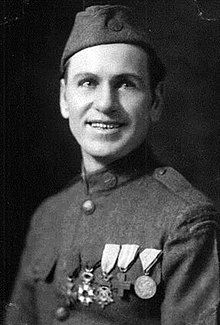
Thomas Croft Neibaur is honored on the following 1 monument(s) in our database:
Thomas Croft Neibaur was born on May 17, 1898, in Sharon, Bear Lake County, Idaho. He was the son of James Cranshaw Neibaur and Elizabeth Jane Croft Neibaur. He was first married to Sarah Lois Shepard Neibaur and later to Lillian Rose James Golden. He enlisted in the Idaho National Guard on March 30, 1917, shortly before the United States entered World War I, and was called into federal service days later. After initial assignments guarding infrastructure in the western United States, he trained with the 41st Division before being deployed to France. There, he was reassigned to Company M, 167th Infantry Regiment of the 42nd “Rainbow” Division.
Neibaur saw combat in several major campaigns, including the Champagne-Marne, Saint-Mihiel, and Meuse-Argonne offensives. During the intense fighting around the Kriemhilde Line, his regiment was tasked with capturing the heights near Châtillon. On October 16, 1918, after his automatic rifle team was ambushed and his comrades killed, Neibaur continued the fight alone despite multiple wounds. His actions helped secure the position and contributed to the broader success of the division.
After the war, he spent months recovering from his injuries, one of which remained with him for life. He returned home to Idaho in 1919 to widespread recognition and was honored in a statewide celebration. In later years, Neibaur struggled during the Great Depression and faced severe financial hardship. Unable to support his family, he famously sent his medals to Congress with the note, “I cannot eat them.” He died on December 23, 1942, from tuberculosis, and is now buried in the Sugar City Cemetery, Sugar City, Madison County, Idaho, USA. Today, his legacy is honored at Thomas C. Neibaur Veteran Park in Sugar City, Idaho, and his medals are preserved by the Idaho State Historical Society. In recognition of his wartime heroism, General John J. Pershing included him among his “Immortal Ten,” a group of soldiers whose courage exemplified the highest ideals of service.
Medal of Honor Citation:
The President of the United States of America, in the name of Congress, takes pleasure in presenting the Medal of Honor to Private Thomas Croft Neibaur (ASN: 98595), United States Army, for extraordinary heroism on 16 October 1918, while serving with Company M, 167th Infantry, 42d Division, in action at Landres-et-St. Georges, France. On the afternoon of 16 October 1918, when the Cote-de-Chatillion had just been gained after bitter fighting and the summit of that strong bulwark in the Kriemhilde Stellung was being organized, Private Neibaur was sent out on patrol with his automatic rifle squad to enfilade enemy machinegun nests. As he gained the ridge he set up his automatic rifle and was directly thereafter wounded in both legs by fire from a hostile machinegun on his flank. The advance wave of the enemy troops, counterattacking, had about gained the ridge, and although practically cut off and surrounded, the remainder of his detachment being killed or wounded, this gallant soldier kept his automatic rifle in operation to such effect that by his own efforts and by fire from the skirmish line of his company, at least 100 yards in his rear, the attack was checked. The enemy wave being halted and lying prone, four of the enemy attacked Private Neibaur at close quarters. These he killed. He then moved alone among the enemy lying on the ground about him, in the midst of the fire from his own lines, and by coolness and gallantry captured 11 prisoners at the point of his pistol and, although painfully wounded, brought them back to our lines. The counterattack in full force was arrested to a large extent by the single efforts of this soldier, whose heroic exploits took place against the skyline in full view of his entire battalion.
Source of information: www.findagrave.com, en.wikipedia.org, valor.militarytimes.com