






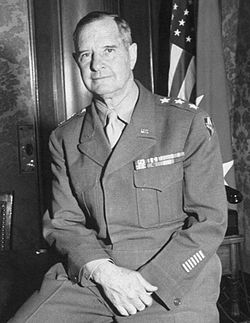
Geoffrey Keyes is honored on the following 1 monument(s) in our database:
Little America in Liefering — The General Keyes Housing Area Information Sign
Geoffrey Keyes was born on October 30, 1888, in Fort Bayard, Grant County, New Mexico. He was the son of Alexander Scammel Brooks Keyes and Virginia Maxwell Keyes. He was married to Leila Harrison Keyes. He entered the United States Military Academy at West Point in 1908 and graduated in 1913 as a second lieutenant in the U.S. Cavalry. He began his military career with the 6th Cavalry Regiment and took part in the Pancho Villa Expedition in Mexico. After his early service, Keyes became an instructor of French at West Point and also served as the academy’s head football coach in 1917, leading the team to a 7–1 record. During the interwar years, he held numerous important assignments, including service with the Panama Canal Division, teaching positions at West Point and the Cavalry School at Fort Riley, and supply leadership roles within the War Department. He furthered his education at the U.S. Army Command and General Staff School and later at the Army War College.
During World War II, Keyes rose rapidly through the ranks. In 1940, he became chief of staff of the 2nd Armored Division. Following the attack on Pearl Harbor, Keyes assumed command of Combat Command B of the 3rd Armored Division and later organized the 9th Armored Division. He subsequently served in North Africa as deputy commander under Patton during the Allied campaigns. In the 1943 invasion of Sicily, Keyes commanded the Provisional Corps during Operation Husky, leading forces that captured much of western Sicily, including Palermo, while taking thousands of Axis prisoners with relatively light casualties.
Later in 1943, Keyes took command of II Corps and led it throughout the Italian Campaign under Lieutenant General Mark W. Clark’s Fifth Army. His corps participated in major operations, including the battles of San Pietro, Monte Cassino, the Gothic Line, and the final Allied offensive in Italy in 1945. He was promoted to lieutenant general shortly before the end of the war in Europe. After World War II, Keyes commanded the Seventh Army and later the Third Army, succeeding his longtime colleague George S. Patton. In 1947, he became the United States High Commissioner on the Allied Council for Austria, a position he held during the postwar occupation period. He later served as Director of the Weapons Systems Evaluation Group before retiring from the Army in 1954 after 41 years of service. LTG Keyes died on September 17, 1967, and is now buried in the United States Military Academy Post Cemetery, West Point, Orange County, New York, USA.
Source of information: en.wikipedia.org