






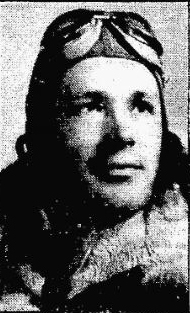
John Warner, IV Reed is honored on the following 1 monument(s) in our database:
John Warner Reed IV was born on June 4, 1917, in Benton Harbor, Michigan. He was the son of John Warner Reed III and Erma K. Thieme Reed. He was married to Lafern Reed. He was a graduate of Benton Harbor High School. He was employed by the Firestone Tire and Rubber Company on Paw Paw Avenue before enlisting in the service in October 1942. After a year of training, he earned his Army Air Forces wings and received his commission as a Second Lieutenant in September 1943 at Pecos Army Airfield, Texas, following primary flight training at Bonham, Texas. He served in the 577th Bombardment Squadron, 392nd Bombardment Group, and as pilot of B-24H #42-7546, nicknamed "Alfred II" during World War II.
On April 29, 1944, the Alfred II departed RAF Wendling, Norfolk, on a daylight bombing mission to Germany. Before reaching the target, the bomber was intercepted by a formation of Messerschmitt Bf 109 fighters and sustained severe battle damage. The aircraft's hydraulic system was disabled, fuel tanks were punctured, the flight controls were damaged, the No. 2 engine was knocked out, the No. 4 engine was badly damaged, and the right rudder was shot away. Reed immediately jettisoned the bomb load and turned the aircraft toward England in an effort to save his crew. As the crippled bomber reached the Norfolk coast, it became clear that the aircraft could not remain airborne. Near Walcott, Reed ordered his nine crewmembers to bail out, and all successfully parachuted to safety. Rather than abandoning the aircraft himself, Reed remained at the controls. The B-24 crashed into a field off what is now Reed Way (formerly Back Lane) at approximately 1:30 p.m., where Reed was killed. Local investigations and later commemorative accounts conclude that his actions not only enabled his crew to survive but also steered the damaged bomber away from the nearby villages of Walcott, Ridlington, Witton, and Bacton, preventing potential civilian casualties.
2Lt Reed is now buried in the Crystal Springs Cemetery, Benton Harbor, Berrien County, Michigan, USA.
Silver Star Citation:
The President of the United States of America, authorized by Act of Congress July 9, 1918, takes pride in presenting the Silver Star (Posthumously) to Second Lieutenant (Air Corps) John W. Reed, IV (ASN: 0-691542), United States Army Air Forces, for gallantry in action while serving as Pilot of a B-24 Liberator Bomber of the 577th Bombardment Squadron, 392d Bombardment Group (Heavy), EIGHTH Air Force, in action on a bombardment mission over Germany on 29 April 1944. A large force of ME-109’s made a vicious attack as the formation approached the target and Lieutenant Reed’s aircraft sustained severe damage. Two engines were disabled, the fuel and hydraulic lines punctured, and the left rudder and stabilizers badly torn by cannon fire. Ordering the bomb load to be released, Lieutenant Reed abandoned the formation and started the long return journey alone. Though the crippled bomber was exceedingly difficult to control, he flew it back to England. Shortly after crossing the English coast, he was informed that the bomb-bay section was choked with gasoline fumes from the leading fuel lines. Rather than risk the lives of his crew from an explosion which could be caused by a chance spark on landing, Lieutenant Reed ordered the entire crew to bail out. When they had all abandoned the stricken plane, he headed for the coast where the aircraft could crash harmlessly into the sea. Before he was able to bail out the aircraft crashed, killing Lieutenant Reed. His gallantry, flying skill, and devotion to duty and his comrades undoubtedly saved the lives of his crew.
Source of information: www.findagrave.com, www.geograph.org.uk, valor.militarytimes.com