






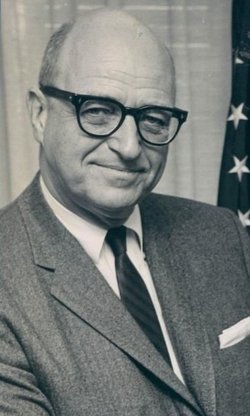
James II Roosevelt is honored on the following 1 monument(s) in our database:
Makin Island Raid 2nd Marine Raider Battalion Execution Plaque
U.S. Congressman, U.S. Marine Corps Brigadier General, Businessman, Oldest son of FDR, retired USMC B General; and, Author. A member of the Democratic Party, he served in the U.S. House of Representatives from California's 26th district for six consecutive terms from January 1955 until September 1965. Born James Roosevelt II in New York City, he was the oldest son of 32nd U.S. President Franklin D. Roosevelt and First Lady Eleanor Roosevelt. He attended the Potomac School and the National Cathedral School in Washington, D.C. and the Groton School, a private college preparatory boarding school in Groton, Massachusetts. After graduating in 1926, he attended Harvard University at Cambridge, Massachusetts. Upon graduating from Harvard, he enrolled at the Boston University School of Law in Boston, Massachusetts and took a sales job with Boston insurance agency and became so successful that within a year, he abandoned his law studies. In 1932, he started his own insurance agency and in 1934, he and Joseph P. Kennedy Sr. (father of U.S. President John F. Kennedy) went to England to obtain the market in post-prohibition whisky imports and was instrumental in securing Kennedy's appointment as the U.S. Ambassador to England. In November 1936, he was given a direct commission as a lieutenant colonel in the U.S. Marine Corps and accompanied his father to the Inter-American Conference at Buenos Aires in December as a military aide. In January 1937, he was officially appointed the administrative assistant to the President and later that year he was appointed Secretary to the President. In October 1937, he became White House coordinator for 18 federal agencies. Following allegations that he used his political position to attract lucrative business to his insurance firm, he resigned his White House position in November 1938. He then moved to Hollywood, California where he became an administrative assistant for film producer Samuel Goldwyn. In 1939, he established Globe Productions, a company that produced short films for penny arcades and then resigned his commission in the U.S. Marine Corps and was commissioned a captain in the U.S. Marine Corps Reserve and went on active duty in November 1940. In April 1941, President Roosevelt sent him on a secret diplomatic mission around the world, meeting with the leaders of various governments, including King Farouk of Egypt, King George of Greece, and Chiang Kai-shek of China, that the U.S. would soon become involved in World War II (WWII). In August 1941, he joined the staff of William J. Donovan, Coordinator of Information, with the job of working out the exchange of information with other agencies. After the Japanese surprise attack at Pearl Harbor, Hawaii on December 7, 1941, he requested and received an assignment to combat duty and served in the Pacific Theater of Operations with the 2nd U.S. Marine Raiders at the Battle of Makin Island. He was then given command of the newly formed 4th U.S. Marine Raiders, but it was invalidated in February 1943, and he served in various staff positions for the remainder of the war. He was released from active duty in October 1945 at the rank of colonel and continued to serve in the Marine Corps Reserve, retiring in October 1959 at the rank of brigadier general. His military awards and decorations include the Navy Cross, the Silver Star, the American Defense Service Medal (with base clasp), the American Campaign Medal, the Asiatic Pacific Campaign Medal (with four service stars), the World War II Victory Medal, the Marine Corps Reserve Ribbon (with 1 bronze star), and the Philippine Liberation Medal (with one bronze star). After the war, he returned to live in California and in 1946, he became chairman of the board of Roosevelt and Haines. In 1950, he was the Democratic candidate for Governor of California but lost to Republican incumbent Earl Warren by almost 30 percent of the votes. In 1954, he was elected to the US House of Representative from California's 26th congressional district and was re-elected to five additional terms and served from 1955 to 1965, resigning during his 6th term. He was one of the first politicians to denounce the tactics of Wisconsin U.S. Senator Joseph McCarthy and was the only U.S. Representative to vote against appropriating funds for the House of Un-American Activities Committee (HUAC). In April 1965, he ran as a Democratic candidate for Mayor of Los Angeles but lost to incumbent Sam Yorty in the primary. In October 1965, he resigned from Congress when President Lyndon B. Johnson appointed him a delegate to the United Nations Educational, Scientific, and Cultural Organization (UNESCO). The following year he resigned from UNESCO and became an executive of the Investors Overseas Service (IOS) in Geneva, Switzerland and resigned from that position in 1971, amid the fugitive financier Robert Vesco scandal. Despite having been a liberal Democrat all of his life, he joined the Democrats for Nixon and publicly supported President Richard Nixon's re-election in 1972 and also supported Ronald Reagan for President in 1980 and 1984. In the 1980s, he established the non-profit organization, the National Committee to Preserve Social Security and Medicare, and its associated political action committee. He died at the age of 83 from complications following a stroke and Parkinson's disease and was the last surviving child of Franklin and Eleanor Roosevelt. He authored several books, including "Affectionately, FDR" (1959, with Sidney Shalett), "My Parents, a Differing View" (1976, with Bill Libby), written in part as a response to his brother Elliott Roosevelt's book "An Untold Story", which told of Franklin D. Roosevelt's marital issues and was fiercely repudiated by the other siblings, and the novel "A Family Matter" (1979, with Sam Toperoff).
Navy Cross citation:
The Navy Cross is presented to James Roosevelt, Major, U.S. Marine Corps (Reserve), for extraordinary heroism and distinguished service as second in command of the Second Marine Raider Battalion against enemy Japanese armed forces on Makin island. Risking his own life over and above the ordinary call of duty, Major Roosevelt continually exposed himself to intense machine-gun and sniper fire to ensure effective control of operations from the command post. As a result of his successful maintenance of communications with his supporting vessels, two enemy surface ships, whose presence was reported, were destroyed by gun fire. Later during evacuation, he displayed exemplary courage in personally rescuing three men from drowning in the heavy surf. His gallant conduct and his inspiring devotion to duty were in keeping with the highest traditions of the United States Naval Service.
For the President,
Chester W. Nimitz
Source: Find a Grave