






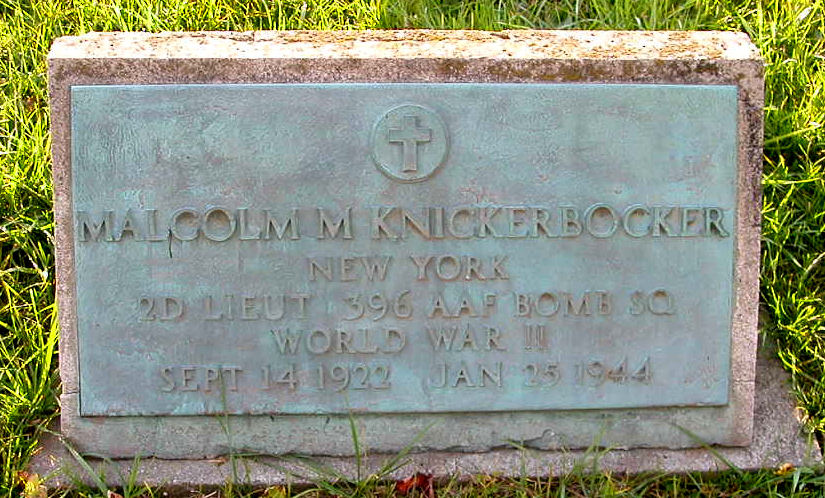
Malcolm Murray Knickerbocker is honored on the following 1 monument(s) in our database:
On Jan. 25, 1944, the 396th Bomb Squadron sent its B-25s against Maloelap. The copilot of one bomber was 21-year-old 2d Lt. Malcolm Knickerbocker, who had left Duke University to join the AAF and had earned his wings only six months earlier.
Lieutenant Knickerbocker was as close to Hollywood's concept of the all-American youth as one could have found. What happened that January day is one of the most poignant stories of heroism in World War II, told in a letter to Knickerbocker's parents from his squadron commander, Maj. Andrew McDavid, and in the citation for the lieutenant's posthumous Distinguished Service Cross.
The B-25s approached Maloelap at wave top level. Enemy fighters had time to get off the ground and hit the B-25s as they swept the base with machine-gun and cannon fire. A 20-mm explosive shell hit his right leg, exploding on contact and completely severing his leg at the hip socket. Crewmen could not remove Lieutenant Knickerbocker from the B-25's cramped cockpit.
Because of the location of his wound, it was impossible to apply a tourniquet. The best that could be done was to administer plasma and reduce the flow of blood with compresses. In a supreme exercise of will, Knickerbocker conquered the shock and pain of his horrible mutilation. He never lost consciousness. The enemy attack continued for 15 minutes while Knickerbocker helped the pilot handle the bomber in evasive maneuvers.
From time to time, he gave crew members a reassuring smile and the OK signal with his thumb and forefinger in an extraordinary display of self-control. He must have known that he could not survive, but he would fight to stave off death until the mission was completed.
The nearest friendly base was at Makin Atoll, an hour's flight from Maloelap. Approaching the landing strip at Makin, Lieutenant Knickerbocker, weakened by great loss of blood, completed the copilot's pre-landing duties.
As the B-25 turned on final approach, a safe landing assured, Malcolm Knickerbocker died. As the crew lifted his body from the plane, they sobbed.
(Sources for the above: Valor In Defiance of Death. Air Force Magazine, April, 1992, and Hale's Handful: The forging of the Seventh Air Force. Major Peter Ellis, USAF, Maxwell Air Force Base, Alabama.)
Immediately after his death, Malcolm was buried on the island of Makin.
Within a few months, Malcolm's story was national news. For example, Malcolm was featured in a story in the Saturday Evening Post on July 15, 1944.
Malcolm's name is listed on the war memorial at Duke University. (Malcolm's younger brother Don would later graduate from Duke.)
DSC Citation
The President of the United States of America, authorized by Act of Congress, July 9, 1918, takes pride in presenting the Distinguished Service Cross (Posthumously) to Second Lieutenant (Air Corps) Malcolm Murray Knickerbocker (ASN: 0-747821), United States Army Air Forces, for extraordinary heroism in connection with military operations against an armed enemy while serving as Co-Pilot of a B-25 Medium Bomber in the 396th Bombardment Squadron, 41st Bombardment Group (M), SEVENTH Air Force, while participating in low level strike mission against the strongly fortified enemy-held atoll of Maloelap in the Central Pacific area on 25 January 1944. After leaving the target, having successfully strafed in assigned areas under the heavy fire of attacking enemy fighters, Lieutenant Knickerbocker, while performing his duties as Co-Pilot, was hit in the right leg by a 20-mm. explosive shell. The shell exploded on contact with the leg, severing it completely at the hip. Despite the fact that Lieutenant Knickerbocker suffered untold pain he did not lose consciousness. Because of the cramped quarters it was impossible to remove him from his Co-Pilot's seat and on account of the type of injury no tourniquet could be applied. First Aid, morphine, and blood plasma were, however, administered. Throughout all this, enemy fighters continued in their attack for another fifteen minutes. Lieutenant Knickerbocker carried on as Co-Pilot, helping the Pilot maneuver through evasive action, holding the power settings and propeller controls, with entire disregard for his critical condition which was progressively aggravated by great loss of blood. On arrival at the nearest friendly base of Makin he assisted the pilot in preparing for landing. As the airplane turned into the final approach to the field, Lieutenant Knickerbocker died. The gallant example set by this officer has inspired his fellow combat crewmen to strive more aggressively for success in their combat missions. Second Lieutenant Knickerbocker's gallant actions and dedicated devotion to duty, without regard for his own life, were in keeping with the highest traditions of military service and reflect great credit upon himself, his unit, and the United States Army Air Forces.
Source: Find a Grave