






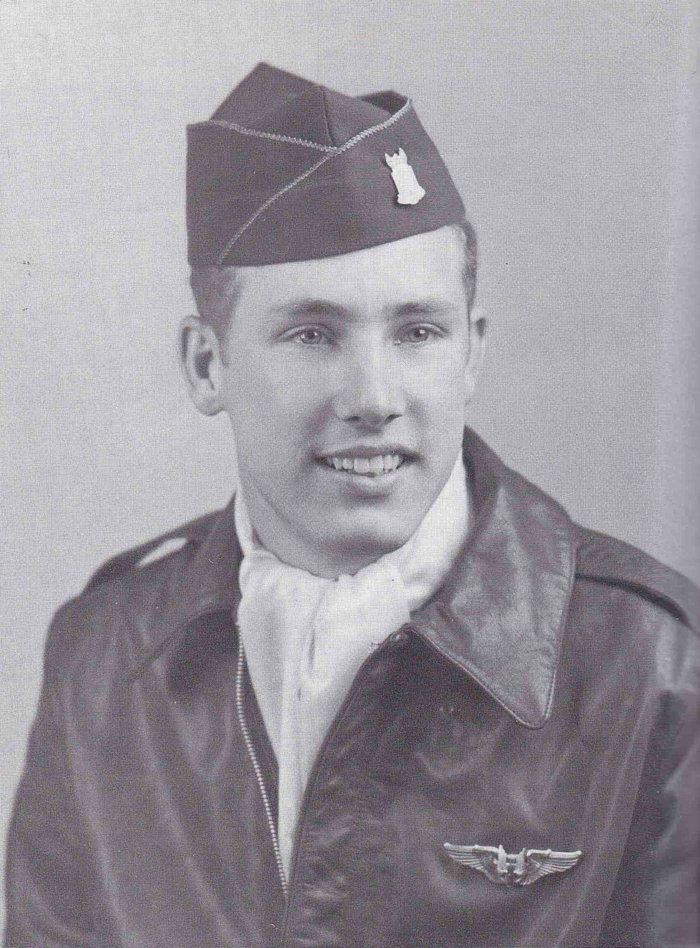
Howard Glenn Goodner is honored on the following 1 monument(s) in our database:
B-24 'Black Cat' (42-95592) Crash Marker -Last Bomber shot down over Germany WW2
Howard Glenn Goodner was born on March 2, 1924, in Etowah, McMinn County, Tennessee. He was the son of Miles Ernest Goodner and Callie Elizabeth Howard Goodner. He attended Bradley High School before continuing his education at Western State Teachers College in Bowling Green, Kentucky. He entered military service on March 17, 1943, and underwent radio training at Scott Field, Illinois, before being sent to England in October 1944. He served in the 784th Bomb Squadron, 466th Bomb Group, Heavy, as a Technical Sergeant and Radio Operator of B-24 #42-95592, nicknamed 'Black Cat' during World War II.
On April 21, 1945, the Black Cat took off from RAF Attlebridge in England on what would become its final combat mission. The bomber was assigned to attack a railroad bridge at Salzburg, Austria, a transportation target that remained strategically important as Allied forces advanced during the closing weeks of the war. On this mission, the Black Cat was serving as a lead aircraft in the formation. Severe weather, however, prevented the mission from proceeding as planned. Heavy clouds and thunderstorms obscured the Salzburg area, and at approximately 10:30 a.m., the mission was recalled. The formation turned back toward England, but its return route took the bombers directly over Regensburg, Germany, where German antiaircraft defenses were still active. According to accounts from the 466th Bomb Group, navigators warned that the formation was heading over the city, but the course did not change. As the bombers passed over the Regensburg area, German antiaircraft batteries opened fire. The Black Cat suffered a devastating direct flak hit to its left wing, reportedly between the No. 1 and No. 2 engines. The impact caused the wing to fold or break away, sending the bomber into a roll as it rapidly disintegrated in the air. Crews aboard nearby aircraft watched as pieces of the Black Cat fell from the sky and reported seeing several parachutes among the falling wreckage. The aircraft's remains came down in the countryside near Scharmassing and Oberhinkofen, southeast of Regensburg. Of the twelve men aboard the Black Cat that morning, only two survived.
TSgt Goodner was thrown from the disintegrating aircraft at an altitude of more than 20,000 feet. Tragically, he did not have a parachute. He fell alongside debris from the bomber toward the Bavarian village of Scharmassing and landed in a field outside the village. He is now buried in the Hilcrest Memorial Gardens, Cleveland, Bradley County, Tennessee, USA.
Sources of information: www.findagrave.com, www.b24.net, callie-graphics.com, www.etvma.org