






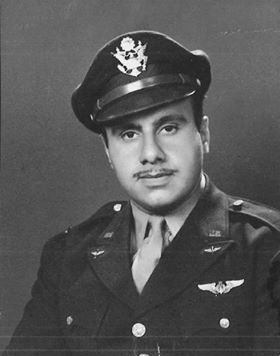
Christ D. Manners is honored on the following 1 monument(s) in our database:
B-24 'Black Cat' (42-95592) Crash Marker -Last Bomber shot down over Germany WW2
Christos Mugianis, better known as Christ Manners, was born on October 14, 1921, in Pittsburgh, Pennsylvania, to Greek immigrant parents Diamandis Mugianis and Mary Vassilaros. His family had immigrated to the United States from the Greek island of Icaria, and in 1940 they changed their surname from Mugianis to Manners to make it easier for Americans to pronounce. Manners enlisted in the U.S. Army Air Corps Reserve on June 15, 1942. He initially pursued pilot training, completing flight time in training aircraft, but after being rejected for further pilot instruction, he entered bombardier training. He attended flexible aerial gunnery school at Laredo Army Air Field and later trained at Midland Army Air Field in Texas, where he learned to use the Norden bombsight. After completing approximately 18 weeks of training, he graduated as a bombardier in May 1944. Manners was subsequently assigned to the crew of pilot 1st Lt. Richard J. Farrington and eventually served with the 784th Bomb Squadron, 466th Bomb Group, U.S. Eighth Air Force in England. Known to his crewmates by the nickname “Curly,” Manners flew combat missions aboard B-24 Liberators and was later part of Farrington's lead crew.
On April 21, 1945, the Black Cat took off from RAF Attlebridge in England on what would become its final combat mission. The bomber was assigned to attack a railroad bridge at Salzburg, Austria, a transportation target that remained strategically important as Allied forces advanced during the closing weeks of the war. On this mission, the Black Cat was serving as a lead aircraft in the formation. Severe weather, however, prevented the mission from proceeding as planned. Heavy clouds and thunderstorms obscured the Salzburg area, and at approximately 10:30 a.m., the mission was recalled. The formation turned back toward England, but its return route took the bombers directly over Regensburg, Germany, where German antiaircraft defenses were still active. According to accounts from the 466th Bomb Group, navigators warned that the formation was heading over the city, but the course did not change. As the bombers passed over the Regensburg area, German antiaircraft batteries opened fire. The Black Cat suffered a devastating direct flak hit to its left wing, reportedly between the No. 1 and No. 2 engines. The impact caused the wing to fold or break away, sending the bomber into a roll as it rapidly disintegrated in the air. Crews aboard nearby aircraft watched as pieces of the Black Cat fell from the sky and reported seeing several parachutes among the falling wreckage. The aircraft's remains came down in the countryside near Scharmassing and Oberhinkofen, southeast of Regensburg. Of the twelve men aboard the Black Cat that morning, only two survived.
2Lt Manners was in the nose of the bomber with his legs extended into the nose-wheel well when the aircraft was hit. The violent spinning initially pinned him to the floor, but he eventually managed to drag himself toward the wheel well and escape from the disintegrating aircraft. He fell several thousand feet before opening his parachute at approximately 10,000 feet. He landed near a building and a creek and was immediately captured by German forces. Manners became a prisoner of war, but his captivity was brief as Germany was already nearing defeat. He was liberated on April 29, 1945, only eight days after the loss of Black Cat. After the war, he continued his military career and received further technical training, including work involving jet-engine overhaul. He eventually attained the rank of Major. He died from a heart attack on January 20, 1963, and is now buried in the Jefferson Memorial Cemetery, Pleasant Hills, Allegheny County, Pennsylvania, USA.
Sources of information: www.findagrave.com, www.b24.net, callie-graphics.com, www.greeks-in-foreign-cockpits.com