






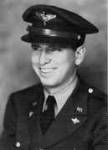
Glenn E. Camp Jr. is honored on the following 1 monument(s) in our database:
B-17 (42-29963) ‘Judy’ & P-51 (42-106855) & Escape Assistance Memorial
2nd Lt Glenn E. Camp Jr., pilot of the B-17 42-29963 “Judy”, took off from station 117 Kimbolton, Cambridgeshire, UK at 0730 on a bombing mission over Ludwigshafen and Solingen. The plane’s no.1 engine suffered a direct flak hit right after bombs away. Wounded, the bomber was harassed by enemy fighters until part of the crew managed to bail out at 1259. Lt Camp originally managed to evade capture but was taken prisoner at the Spanish border and sent to Stalag Luft 1 in Barth-Vogelsang Prussia.
From Find a Grave:
Glen Camp, Jr was a graduate of Austin High School in Texas. He attended the College of Mines for two years and the University of Texas for one year, before joining the Army Air Forces. In September of 1942, he began his pilot training as an aviation cadet at the Army Air Corps Flying School at Maxwell Field in Montgomery, Alabama. By early 1943 he was at the Army Air Forces flying School in Walnut Ridge, Arkansas working on the second phase of training in obtaining an officer's commission. Then in March, 1943, he was an aviation cadet at the Army Air Forces Advanced Flying Academy in Seymour, Indiana where upon his graduation, he received his wings and was commissioned a 2nd Lieutenant. He was then assigned to the 19th Bombardment Base at Pyote, Texas in July, 1943 for advanced training as a pilot for the B-17 Flying Fortress. He married Alice Adams in October of 1943. They divorced after the war in 1947. He would later marry Nancy Will in October of 1948.
After completing advanced B17 training, 2nd Lieutenant Glen E. Camp, Jr was assigned to 527th Bomb Squadron, 379th Bomb Group (Heavy), Kimbolton Air Field, England. He was the pilot on December 30, 1943 of B-17 #42-29963, nickname "Judy."
On December 30, 1943, they took off from their base in England with a large contingent of bombers and fighter escorts. The target of this bombing mission was the IG-Farben chemical complex and the port area of the city of Ludwigshafen, Rhineland. The "Judy" was hit over Ludwigshafen. The bomber was still able to deliver its payload on target, but was losing power and was gradually fell behind the formation. However, Lt. Camp was able to maintain air flight and continued on for England.
Once over France, flying above the department of Oise, the damaged B-17 "Judy" was attacked three times by German fighters. The number 1 engine was out and would not feather, thus creating more drag. The number 2 engine was acting up, and the tail section was shot away by 20 mm cannon fire. The gunners fought back with Parker and Pierce, both shooting down enemy aircraft. Pierce was then hit by enemy fire and probably killed. Other crew members were also wounded and others presumed dead. The Flying Fortress was becoming uncontrollable. Lt. Camp ordered his crew to evacuate the aircraft.
The B-17 "Judy" hit the treetops and disintegrated in the Bois Morel, in the territory of the municipality of Ully-Saint-Georges (Oise). Among the wreckage, three bodies were found: those of the co-pilot Joseph F. Fitzgerald, ball turret gunner Marcus C. Pierce, and tail gunner Robert Cross. The body of gunner Richard R. Giersch was found in a field near the scene of the crash with an unopened chute having bailed out at a low altitude. The surviving airmen were quickly hidden by the French Resistance.
The bodies of the four airmen were buried the next day in the cemetery of Boran-sur-Oise, France. The other six surviving airmen received help via Free French escape lines and French families did not hesitate to provide immediate help to the survivors throughout their escape. Indeed, years later Glenn Camp spoke highly of the assistance he received from the French and still remembered the French he learned while hidden by the underground.
Farr, Donaldson, Parker, and Mills were assisted by the French and returned to Scotland and England via different routes. Camp and Cooper were hidden by the French underground for 4 months and were on a train and close to the Spanish border with 8 other downed flyers when they were captured by the Germans on May 5, 1944. They were incarcerated in the prison of Bayonne, then in Fresnes. Later they were sent to Stalag Luft I at Barth, in northern Germany where they survived on a diet of cabbage soup and black bread. They were liberated by the Soviet Army on May 1, 1945 and Glenn made his way to France, where he was able to write his parents as he awaited sea transport back to the United States.